It’s a mess!

20160801_204641

Messy room

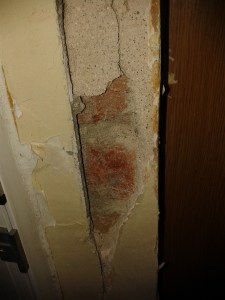
It started with a hairline crack near the door, just a split in the wallpaper, but underneath I felt loose plaster. When we moved into the house I had painted over three (yes, three) different patterns of wallpaper to brighten up the small room, but I wouldn’t get away with a quick lick of paint this time.

For a long time, I tried to ignore the grubby marks and the widening cracks on the wall. Recently I gathered my courage, borrowed a steamer from a friend and set to work. As I pulled off the stiff paper chunks of plaster came with it. The next day, I found a few of them hidden in my dog’s blankets. She decided that they were big enough to be worth gnawing on.

Now that the wallpaper’s off, we see the mottled, stained walls underneath. A big hole goes right down to the bricks and I still have to chip out more loose plaster around it. The place is a mess.

Messy life

Recently at Mass, I heard the passage in Jeremiah 18 where God compares Himself to a potter making something new out of a lump of clay that didn’t turn into anything worthwhile at the first attempt. The priest said that even if our lives are in a bad state, we can hand the mess over to God and trust Him to create something new. After Communion, I knelt down in prayer and thought about the messes in my life.

I thought about leaving the religious tradition in which I was brought up, which gave me certainty and security and the approval of my family. I thought of the anger I came to feel against religion, which caused me to oppose any kind of religious upbringing for my children. I thought of the force, which I might call God, which drew me into a mystery where there are no clear-cut certainties. This path eventually led me into the Catholic church.

I am in a place where I am like a little child, having to learn things again. It’s messy and painful. I feel that I have let my family down, both the older and younger generation, for different reasons. On that particular day, I was staying with my parents. I felt intense guilt for telling them that I was going out for a walk and a cup of coffee without also mentioning that the walk included a detour past the local Catholic church where I attended Mass.

Handing it over to God

Before I became Catholic, I asked our priest what difference taking Holy Communion would make. He looked me straight in the eye and said, “It will move you to tears.”

I couldn’t do any more with my mess and I tried to hand it over to God. This time, I couldn’t hold back the tears. I have often been damp-eyed after Communion, but I have never let go and cried with such abandon.

Nothing looks the way I (and I imagine many other people in my life) think it should. I don’t understand what is happening, but I think of the broken walls in room I am decorating. Once I took off the wallpaper, the walls looked an awful lot worse. Maybe things have to be stripped down to the core, revealing an even bigger mess, before anything can get better.

WMD


20160801_204527

WMD – we all know what that means. Those were the Weapons of Mass Destruction which Bush and Blair failed to find in Iraq. Around that time, I saw a sketch on Gaelic TV where two soldiers marched into a small shop in the Highlands and demanded that they hand over their WMD. The shopkeepers looked puzzled, and then one of them triumphantly lifted out a huge, black, bomb-shaped sausage and presented them with Willie’s Marag Dubh (Willie’s black pudding).

Nuclear defence

The UK has four nuclear submarines based in Scotland on the Firth of Clyde, in an area of great natural beauty. The base at Faslane is close to an inlet called Holy Loch, where St Munn, one of the first Irish saints, is meant to have landed in Scotland, and where the previous nuclear base was situated. A few days ago, British MP’s voted to renew Britain’s submarine-based nuclear defence system by a huge majority of 355. All but one of the Scottish MP’s voted against its renewal, but that’s another story.

Even though I have definite opinions on other recent issues, such as the Scottish independence referendum and the vote on leaving the European Union, I have tried to appreciate other peoples’ points of view. Well, I have often argued in a stubborn way, but afterwards, I have thought about what other people said, and have been able to understand why they have come to different conclusions from me. However, I simply cannot understand the argument for spending an unknown amount of money on weapons which could kill 100 000 people in one go.

If faith should affect all of my life rather than being compartmentalised into a wee box labelled ‘Open only on Sunday’, then it has to affect political opinions and decisions. I have wanted to keep politics out of this blog, but I feel that if I don’t find some way to say I am against nuclear defence, then I am quietly giving my assent.

Gerard W. Hughes was a Jesuit priest and writer who wrote a great deal about the split spirituality which has led to many Christians seeing nuclear weapons and ‘just’ war as a means to preserve peace. In the book ‘God in all things’, he said that if someone who supported nuclear defence, really allowed God into their prayer to make them aware of their actual thinking, it might go something like this:

Dear Lord, inspire our scientists that they may invent yet more lethal weaponry (so that our deterrent may prove even more effective). Protect us from any unfortunate accident in its testing (lest it destroy us and our own cities rather than our enemies). Bless our economy that we may put these weapons into plentiful production (otherwise we cannot deter). Have a special care of the hungry, the homeless, the sick, and the aged of our own land and of other lands until such time as our defence commitments allow us to contribute a little more to these worthy purposes. Strengthen our leaders in a strong defence policy. Drive out from our midst any who by thought, word or deed undermine our national security, and grant us the protection of nuclear weaponry now and forever.

Letting go of my own defences

It’s strong stuff, a bit like a modern version of Robert Burn’s ‘Holy Willie’s Prayer’ where Holy Willie, an elder in the kirk, praises his own holiness, skirts over his sins, and asks God to blast his enemy’s cabbage and potatoes!  However, lest I become complacent and congratulate myself for being against nuclear defence, I should consider what Gerard W. Hughes says a little later in the same book:

It would be wonderful if we could overcome the dangers of pollution and global warming and if all nuclear weapons could be destroyed…. But we would not be secure until we had tackled and eradicated the roots of our own violence, hatred and aggression. Holiness is about this eradication. Holiness is like a light that uncovers our pretence and our hypocrisy.

I might not be able to do much about the decision to build a new nuclear defence system. However, I can ask God for help to bring peace into my own little patch. I can ask God to show me my own hypocrisy, and the areas in my life where I am aggressive or prejudiced. True peace is painful, because it involves letting go of fear, becoming vulnerable and being open to others. Before we are ready to get rid of our huge systems of nuclear deterrence, we might have to build peace one person at a time.

Honour

20160616_090922

Three temptations

Bishop Robert Barron in his book ‘Catholicism’ says that humans face three great temptations: sensual pleasures (including money), power and pride. He goes on to show how Jesus was tempted in each of these ways and overcame them, after his forty days in the desert.

I have recently been reading ‘Selfish Society’ by the parent-infant psychotherapist Sarah Gerhardt who identifies three very similar traps. She shows how babies who fail to develop a nurturing bond with a parent or parent figure in the early years of their lives will often try to compensate later on by pursuing material wealth, power or recognition.

She uses research on attachment in babies and the latest advances in neuroscience to show that small babies need a close, nurturing relationship in order to develop empathy and a genuine concern for others. Unfortunately, many parents struggle to develop good relationships with their babies due to the hurt that they themselves received as children as well as pressures from wider society. Sarah Gerhardt gives an interesting analysis of how society has developed to put pressure on parenting and family relationships.

I am getting a lot more from reading ‘Selfish Society’ than from the parenting handbooks which cajoled me into becoming a better, more efficient parent, and left me feeling inadequate when their advice didn’t ‘work’. It has helped me understand why I have struggled at times to build loving relationships with my children.

No longer the golden girl

Out of the three temptations, my weak point is seeking honour and recognition. I don’t like power (although I can sometimes be a control freak) and am indifferent to money as long as I have enough to pay the bills (which is perhaps not as indifferent as I should be). However, a substantial part of me wants to be admired and praised and throws a stooshie (creates havoc) when I amn’t.

Before having children caught up with me, I was very career-focussed. I strove for excellence in my work and received praise and recognition. Sometimes I received awards without even being aware that there was some kind of competition. I worked hard, and although I remained a smallish fish, I was proud of myself for swimming upstream like a salmon and with great effort flinging myself over the rocks into the big pond.

I took it all for granted, until I became a mother. Despite working as hard as I could, the honours and praise began to dry up. Eventually I exchanged an exciting career to become the family cook, bottle-washer and bum-wiper. I was no longer the golden girl, and on top of that I was getting wrinkles! My recent attempts to return to work, have meant retraining and starting again at the bottom.

You’d think that these experiences might have made me indifferent to honour, but, no, it’s still alive and kicking, like an ageing popstar who is past it, but still poses in a tight, shiny outfit that shows off rolls of fat.

One voice among many

Writing a blog is another temptation to seek honour. A part of me wants to collect likes and followers and readers, and thinks that I have failed when I don’t. Another part of me, knowing what the first part is like, has wondered whether it is wise to venture onto the internet at all. All the thoughts I had about becoming a Catholic threatened to boil over if I didn’t do something about them. I wrote the first draft of this post early one morning when I woke up with thoughts turning round in my head. Sometimes I have no peace until I write them down.

Instead of seeing the internet as an online space where I jostle with other people for a little bit of attention, and possibly praise, I’ve begun to turn this on its head. The internet is a way for many people to express themselves, including those who might otherwise have no way to share their thoughts and feelings. The apparent randomness of internet search engines and WordPress readers allows one voice to momentarily be heard and then sink back into the crowd.

When I thought about blogging in this way, I felt relief. I don’t want to stand out, at least, the deeper, wiser part of me doesn’t. All I really want is to express what I am thinking, and if that makes a connection with someone else, well and good, and if it doesn’t, that’s also fine.

I’ll end with a quote from Thomas Merton’s autobiography, ‘Seven Storey Mountain’ in which he describes his first impression of the Trappist monastery which eventually became his home. Oh, and by the way, please don’t like this post (even if you do)!

The logic of the Cistercian life was, then, the complete opposite to the logic of the world, in which men put themselves forward, so that the most excellent is the one who stands out, the one who is eminent above the rest, who attracts attention.

But what was the answer to this paradox? Simply that the monk in hiding himself from the world becomes not less himself, not less of a person, but more of a person, more truly and perfectly himself for his personality and individuality are perfected in their true order, the spiritual, interior order, of union with God, the principle of all perfection. Omnis Gloria ejus filiae regis ab intus.

The logic of worldly success rests on a fallacy: the strange error that our perfection depends on the thoughts and opinions and applause of other men! A weird life it is, indeed, to be living always in somebody else’s imagination, as if that were the only place in which one could at last become real!

Uncertainty

20160608_132156 (1)

The biggest problem I have is with trust. I have trouble trusting God, my family, my friends, politicians and even myself. Well, I might be right not to trust the last two on this list!

When I don’t trust God, it damages my relationship with others. It’s hard to hope, be open to new ideas, or take risks. It’s difficult to embrace others’ success rather than reacting with jealousy. At the moment, I’m going through a time of uncertainty in my personal circumstances. When I woke up on Friday morning, after the EU referendum result, it was in a country which faces a time of change and uncertainty. This will inevitably affect my own family.

I’m apprehensive about the future. I want to know right now what is going to happen, and when an immediate answer isn’t forthcoming, I throw a tantrum. I am behaving like a spoilt child at a snack break. Rather than sharing the biscuits with others, I want to keep them all to myself. I don’t just want my biscuit for today; I want one for tomorrow and the next day and the next.

What I don’t realise is that the biscuits will go off if I try to hoard them. If I really trusted the person who provided the biscuits, I’d know that they would provide what I need tomorrow and the next day. The trouble is, I don’t trust. I want everything right now.

Sometimes, lack of trust takes another form. I huddle into myself and lose hope. I become convinced that God has forgotten about me, or that I simply don’t matter to Him anymore.

In his book ‘The Second Greatest Story Ever Told’ (thanks for the recommendation!), Fr Michael Gaitley says that “sin begins with a lack of trust.” Okay, so it’s not just me. He goes on to say that our lack of trust comes from a distorted image of God. He describes God’s dealings with mankind in the Old and New Testaments and through the church since then as “God’s school of trust.”

Today I realised that while I might assent to the Gospel at head level, my fear and lack of trust shows deep unbelief at another level. If I really believed that Jesus is the good shepherd, then I would wait patiently until he showed me where I’m supposed to go next. If I really believed that God notices when a sparrow dies, then I wouldn’t give up in despair, convinced that he’s forgotten about me.

So many things in my life, like the political landscape I live in, are out of my control. However, I can’t even manage trust. I fail at that too. Like St. Therese, all I can do is hold out my arms like a little child and ask God to pick me up.

I think of John Henry Newman’s hymn ‘Lead, Kindly Light’ where he says “I do not ask to see the distant scene; one step enough for me”. I also think of Norman MacCaig’s poem, “Something Still”. It’s about a relationship which was good, but something has gone wrong. In the last verse, the poet says,

Disregard your empty hands.

It is not nothing in your fingers

That aches, but the impossible greed

To hold at once all your tomorrows.

That just about sums it up. If I can get over my impossible greed to know that my tomorrows will be provided for, I’ll be able to see that I have what it takes for today.

That dreaded word conversion

20160605_175919

I remember being totally confused as a little girl, when I heard my uncle talking about a barn he had converted. Had the barn undergone some kind of religious experience?

I left the Protestant church I was brought up in and searched for some alternative belief system or set of experiences which would bring meaning to my  life. From time to time, I came across people who convinced me that I needed to be converted. It never came to anything. A few days later, after the euphoria died down, I remained the same messed-up self that I was before.

After trying it several times, I gave up and shrunk away from anything which smacked of conversion. I wouldn’t have said that my life wasn’t in need of improvement, but I didn’t feel that I could change according to a formula. I stopped going to church altogether, and would have described myself as an agnostic who leant towards a belief in God.

Conversion is a very personal thing. You can’t force it on anyone. A human being might look at the barn and decide that it needs to be converted into a studio flat. From the cow’s point of view, however, conversion would be a disaster. It would turn the barn into something totally useless.

Caught in the end

For various reasons, I started attending the Catholic church. Despite my aversion to conversion, I was caught in the end.  I can remember exactly where I was sitting in the church and what the priest was saying. He was telling a story about someone who asked him if he expected to make any conversions to Catholicism. He paused, and I waited, knowing that if he told us that he expected to make converts, then I would be out of that church as fast as my legs could carry me, and probably never come back. I hated the trapped feeling I got when someone didn’t accept me as I was, but just saw me as a potential proselyte.

“I leave conversions to God”, was what the priest actually said. Instead of feeling relief – I was let off the hook, wasn’t I? – I experienced disappointment. Until that moment, I had not realised that I actually wanted to become Catholic. I found out that I actually wanted someone to convince me that there were good reasons for me to convert.

The thought was so daring and so strange for someone brought up strict Protestant, that I didn’t know what to do with it. I hugged it to myself like a joyful secret, reasoning that if it was from me, it would fade away, but if it was from God then I wouldn’t be able to get rid of it. After six months, the thought still hadn’t disappeared and I realised that I would have to do something about it.

No-one cheers you on

On my journey to becoming a Catholic, I was by turns frustrated, disappointed and relieved that I received little encouragement. Catholic friends were politely interested. The priest made himself available to discuss things, but left it up to me to decide if I wanted to return with more questions.

After making a decision to be received into the church, things seemed to get even harder. I wouldn’t go quite so far as to say that I was so discouraged, but it felt disappointing. If I was planning on joining a Protestant church, I would have been the centre of attention. People would have been solicitously cooing and clucking over me, like a newborn baby. As a wannabee Catholic, I felt that I had to give each door a hard shove before it opened.

I realise now, of course, that people were giving me space. They didn’t want to put me under any kind of pressure and were keeping their distance, so that I could back away with dignity if I felt it wasn’t for me. They knew that if what was pulling me into the church was from God, then it wouldn’t be snuffed out by a draught of cold air.

That loaded word conversion

A while ago, I took part in a survey of religious converts, to or from any kind of religion, being carried out by Leeds Beckett University. If anyone is interested, the survey is open until 30th June 2016. Their initial findings show that about two thirds of converts experience a ‘light bulb’ moment when they realise that they have to change their belief system, just as I did. However, this moment of decision doesn’t come out of the blue, but after extensive reading about the new belief system.

So where does that leave me with that loaded word conversion? It speaks of dusty things from the past being ripped out and replaced with squeaky clean surfaces, sparkling bathrooms and smooth floors. I couldn’t live up to that image, and in the end, didn’t want to even try.

A change of direction may creep up on us gradually. In my case, there was a definite moment, an instant, in which I recognised that change of direction. However, a change of heart is a slow, lifelong process. I have to be patient with himself.


Protestant or Catholic?

sunset

Am I Protestant or Catholic? I’ve been received into the Catholic church, but as far as identity goes, this isn’t an easy question to answer. Over the past few weeks I’ve had exhausting dreams in which I’ve been attending Mass, and then rushing off to go to one or other of the Protestant churches I attended as a child.

When I decided to become Catholic, my husband, who was raised Catholic, warned me that I would always remain Protestant. At the time, I dismissed his comment, because I had been through huge changes in my thinking and beliefs. I felt that I was already more Catholic than Protestant.

Now that all the excitement and euphoria and challenge and worry of converting has died down, I realise that he made a very astute comment. I was brought up steeped in the Highland Protestant tradition. From my mannerisms and background, people assume that I am Protestant, and in a way they are right. I can’t change the fact that my Protestant background is woven into me, a fundamental part of my identity.

I have chosen to become Catholic, or perhaps it is better to say that I was invited to become Catholic; the idea certainly didn’t originate with me. After making a long hard journey into the church, it is painful to realise that Catholics will always spot me as someone who wasn’t brought up in their tradition. Sometimes I feel as if I am going around with a label pinned to my back which reads ‘Brought up Protestant’. Not only that, people in the know can often work out, after a short conversation, exactly which flavour of Scottish Protestant.

Where am I in all this, caught between two traditions and not really belonging in either? Before I was received into the church, a priest told me that I would always have my Protestant identity. He said that becoming Catholic was like adding another layer of clothing on top of the Protestant layer on which was already there. He told me that I didn’t need to lose my Protestant identity, or try to distance myself from it. His words gave me comfort at a time when I was worried that I was betraying the people who had loved me and brought me up and taught me to worship God in a particular kind of way.

I understand better now that I can’t and shouldn’t try to remove that Protestant layer, even though it can at times feel so deep and strong that I wonder if I really am in any way Catholic. In Mass recently, I had an image of the Protestant part of me as being like a thick, deep layer of soil. Into that grows a Catholic root, long and strong enough to go right through the soil, down to the core of my being, the quiet place where God speaks and identity no longer matters.

I need the soil to nourish the plant, as well as the plant to bring life to the soil.

So, am I Protestant, or am I Catholic? The best answer I can give is that I am both, but that I am a practising Catholic. That is confusing and difficult for me, and perhaps also for other people, but I hope that God works in the pain and the discomfort of being neither completely one thing or the other.

Travelling …

Canach is on her travels and seeing some lovely parts of Scotland. Not much internet access, but that is probably a good thing!

20160420_202330

I’ve heard some good news from my friend who was separated from her son. A decision has been made and he will be coming back to live with her. I really hope that everything goes well. I have appreciated people saying that they would pray for her. Sometimes when you care about someone and you’ve been worrying and trying to pray for them for a long time you get kind of, I’m not sure what the word is, reconciled or exhausted. At that point, prayers don’t feel very effective, and so it’s good to know that a few other people are adding theirs. Thank you.

Schroedinger’s cat attempts to go to church

20160411_163921

I recently faced a dilemma which most converts come across at one time or other: What do you do on Sunday when you are visiting your non-Catholic relatives? There were three possible options:

Option One – attend the Protestant church with my parents

Because I more or less developed an allergic reaction to any form of organised religion (see Don’t go to church), this was a sticky option. I had pointedly avoided my parents’ church for years. I wondered if I should go to show respect for their beliefs, and to make the point that I have changed. Before I announced that I was becoming Catholic, a request to attend my parents’ church would have been met with unreserved delight, and hope that I was finally seeing the light. However, nowadays it could potentially cause a lot of embarrassment. I had no idea what I would say if some well-meaning person turned to me after the service and asked, “Which church are you going to these days?”

Option Two – attend Sunday Mass at the local Catholic church

I grew up near this church. My friends and I dared each other to run past the gates, screaming in terror. A few years later, I considered it a normal part of life that the boys from our school would beat up the boys from their school. I was secretly proud that the boys from our school won most of the fights, or so they said.

When I walked into the church to light a candle, I felt uncomfortable almost to the point of feeling sick. It was the second hardest thing I ever did after telling my parents that I was going to become Catholic.

Option 3 – don’t go to church at all

A friend of mine, who is also a convert, gently pointed out that it was possible to just do nothing and not go anywhere. I didn’t find this option very attractive, because it seemed like reverting to the default position I had held through all the long years of agnosticism. I was afraid of disappointing God by just doing nothing.

Decisions

I tried to pray, and ask which choice would lead me a little further along a path of peace and reconciliation. However, I received no clear answer. All through Saturday, and even on Sunday morning, I was as undetermined as Schroedinger’s famous cat, whom Terry Pratchett said could be dead, alive or bloody furious. I was in a superposition of states; I simply did not know what to do.

Shortly before I would have to go out, if I wanted to make it to any kind of religious service, I realised that I was in a state of such tension, that I would become physically ill if I tried to attend church. I fell back to default position 3 with a bump. I wasn’t going anywhere, and the relief unwound at least five knots in my stomach.

I worried that I had let God down and disappointed Him. Doubts snapped at my heels like yapping terriers. Why on earth did I have to rock the boat by becoming Catholic? Why couldn’t I have just shut up and put up, and remained in the Protestant church, even though I was never really at home there, and towards the end felt pretty miserable. Perhaps I was meant to feel miserable.

On Monday morning, seeking some kind of peace or at least a feeling of resolution, I set out on a long walk, which I timed to coincide with Mass. When I arrived at the Catholic church, about forty elderly people were already there saying morning prayer beforehand. I didn’t have a Missal and I didn’t catch all the words, but what I heard was enough. The Psalms and Gospel verses reaffirmed my faith. I was participating in something which went far beyond my troubles. I could only see a few dozen people with greying hair, some of whom very obviously had their own physical ailments, but these prayers were being said in churches across the world. This dark, echoing, rather ugly church seemed in some mysterious way to graze the edge of something much, much bigger. I felt still and safe in what had once been the heart of the enemy.

After Mass, I had an image of myself as a tiny, frail bird. In my mind’s eye, it was bright yellow, like a canary, but it couldn’t have been a canary, because I can’t sing for toffee. I imagined that Christ was holding the tiny bird in His hands and gently protecting it, because it was too small and weak to fly far.

I felt that He was gently reproaching me for my contortions, when I tried to stretch tiny wings and be in two places at once. He knew that Option 3 is the only one I can manage right now.

He is in both places, but I can only be in one. Someday, when I am strong enough and whole enough, He may send me out to flit between the two places, but it will be a thing of lightness and joy, and not a fearful obligation. I will know within myself when it is right.

Two sides of Easter

20160330_073318

When I was a child, Easter meant eating Cadbury’s cream eggs which covered my hands with goo. My Mum also gave me a boiled egg to decorate with felt tip pens. Lurid blue and green ink smudged on the egg white when I cracked it open, but I ate it anyway. Back in these good old days, there was no such thing as non-toxic ink, and so I if I’ve turned out to be a little bit wacky, I’ll blame it on that.

Joy

Easter, like Christmas, was a strictly non-religious experience, because we didn’t celebrate it in church. I was a student living away from home when I went to my first Easter day service in a Baptist church. It should have been a joyful experience. The church was packed with smiling people, and the choir sang their hearts out, but I felt annoyance, bordering on anger. I had been brought up with such an emphasis on Christ’s suffering and death that I couldn’t understand why they were so happy.

My next Easter experience, many years later was Mass on Easter Sunday. This time I was much less resistant to joy. I was almost overwhelmed by the different sensations: light from the candles, the smell of incense, the sound of singing, the feel of droplets of holy water, from a brush which the priest flicked enthusiastically over the congregation.

At that point, I didn’t understand Lent, or the fact that Easter Sunday is the culmination of a week of preparation which follows the last week in Christ’s life, his death and resurrection.

Sadness

My experience of Easter is like a patchwork. Due to other commitments, I can’t take part in everything, and even if I could, I don’t think I could take it all in at once. This year my new patch in the Easter quilt was a short time of prayer in the church early on Good Friday.

I couldn’t take part in the Maundy Thursday Mass or the Good Friday prayers, but I saw that there was prayer in the church from Thursday night until Friday morning. I gathered my courage and slipped in for a few moments between dropping the kids at school and going to work.

The church felt different. The statue of Christ was draped in cloth and a curtain partly covered the entrance to the side chapel. I crept into the side chapel and found empty rows of chairs facing a little brass box surrounded by a profusion of flowers. The atmosphere was that of a Chapel of Remembrance. It felt as if someone had died. The church itself was a bare shell, too large for the swaddled figure of Christ and the gaping doors of the tabernacle.

Although I had read that the sacrament is taken out of the tabernacle and placed elsewhere to symbolise Christ’s death and burial, it was a shock to see the church like this. Somehow I had thought that these ceremonies occurred later on Good Friday, and had expected to find the church in more or less normal condition.

Even though this was a re-enactment of events which occurred over 2000 years ago, it felt like a bereavement. I knelt in the side chapel and cried as if I had lost a loved one.

Balance

Mine is not a certain faith. I shuffle forwards, testing each step. I keep going, not because I have any assurance that there is anything beyond what my five senses can tell me, but because of a feeling, deep down, that this is what I am meant to do.

The sadness I felt in finding the church empty, testified in a reverse way to the fact that there must usually be a presence there, even if I have no strong awareness of it. The grief I felt at finding Christ symbolically entombed, showed me that, even through the muddle and guddle of everyday life, a part of me longs for him.

I joined the Easter vigil on Saturday, when light is brought into the dark church from a fire lit outside in the night. Throughout the next few days when doubts pecked at me like black corbies, or crows, I remembered that I cannot understand light without knowing darkness, life is precious because we also experience death, and that faith arises from questions and doubts.

God’s providence

Another thing I’m getting used to about being Catholic, is the mysterious habit people have of leaving cards with prayers or thoughts on them at the back of the church. A short while ago, the table at the back of the church was scattered with prayer cards. Someone must have bought a bumper pack. I eyed them suspiciously, turned one over, and decided that I wouldn’t take any. There were too many to choose from, and someone else might need one more than me.

About two weeks later, there was only one sort of prayer card left. Since nobody else wanted them, I decided to pick one up. I was feeling pretty useless that day. The things that were happening in my life were difficult, and didn’t seem to make much sense. I read the prayer, as I walked away from the church, and it spoke right to me, particularly the part about perplexity. It gave me assurance that even when things are painful and confusing, God is still at work. Here it is.

God’s providence by Cardinal John Henry Newman

God has created me to do Him some definite service; He has committed some work to me which He has not committed to another. I have my mission – I never may know it in this life, but I shall be told it in the next. I am a link in a chain, a bond of connexion between persons. He has not created me for naught. I shall do good, I shall do His work; I shall be an angel of peace, a preacher of truth in my own place, while not intending it, if I do but keep His commandments and serve Him in my calling.

Therefore I will trust Him. If I am in sickness, my sickness may serve Him; in perplexity, my perplexity may serve Him; if I am in sorrow, my sorrow may serve Him. He does nothing in vain; He may prolong my life, He may shorten it; He knows what He is about. He may take away my friends, He may throw me among strangers, He may make me feel desolate, make my spirits sink, hide the future from me- still He knows what He is about.