Is God extravagant?

Flowers

I didn’t usually notice the flowers in the church, but they were particularly beautiful. While I was admiring the mixture of creams and whites and greenery in front of the altar, I realised that there were another two vases on either side of the altar. Two smaller vases stood on either side of Jesus’ feet. Mary hadn’t been left out; she had two vases of her own, making a total of seven.

Seven vases of flowers. Who needed that many in a church?  They served no purpose except to look nice and add a bit of grace to the altar. Surely one wee bunch could do the job. They were nice to look at, but we could do without them. The only flowers that made it into the wee church of my childhood were the silk ones on the ladies’ hats, and it never occurred to us that a few fresh ones might brighten the place up a bit.

These flowers were lovely, but was it right to buy expensive ones like lilies. I hated to think how much they had cost. Come to think of it, should the church be buying any flowers? They would be better spending the money on the poor.

Hmm. Wasn’t there a Gospel story which went something along these lines. I thought a moment, and then I had it. Mary anointed Jesus’ feet with expensive perfume, and then Judas Iscariot complained about the extravagance, suggesting that the money could have been better spent on the poor.  Jesus accepted Mary’s extravagant gift by gently rebuking Judas, ‘You will always have the poor, but you won’t always have me.’ (John 12:8)

I accepted the rebuke and bent my head to concentrate on the Mass. If someone wanted to spend money filling the church with beautiful flowers as an expression of their gratitude to God, who was I to judge?

Everything in moderation?

After I got home, I realised that my cramped reaction to the flowers was very similar to my reaction to the Roman churches filled with art and decoration. My feeling in both cases was that neither flowers nor paintings were necessary in churches. A little of  both might be permissible, but to fill the church with decoration was extravagant. Things like flowers and paintings which are there simply for their beauty, are probably just as indispensable as sleep.
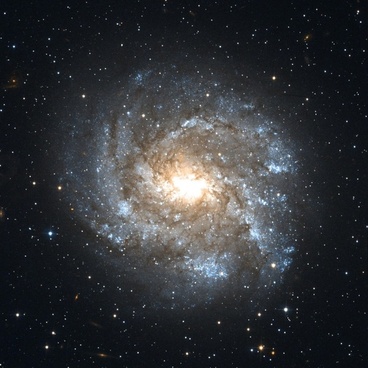
ngc_2082_barred_spiral_galaxy_constellation_schwertfisch_216380

When we collect, appreciate and try to create beautiful things, we are imitating God. He gives us beauty in profligate, reckless abundance. On top of our own world teeming with life, we have been given the amazing and humbling vastness of space. Here are a few facts:

  • If you look up at the sky on a clear night, you will see a white smudge stretching across the sky. You are looking into just one of the spiral arms in our local Milky Way galaxy.
  • The sun is just one of 100 billion stars in the Milky Way galaxy.
  • There are thought to be around 100 billion galaxies in the observable universe.
  • It takes light, travelling at 300 000 000 metres per second, four years to reach us from the closest star Proxima Centauri.
  • Andromeda, our closest galaxy, is 2.5 million light years away.

Have a look at the  scale of the universe . It is a great site which attempts to give people some kind of idea of the immensity of the universe.

Is God extravagant? There is no such thing as moderation when it comes to the universe. The facts speak for themselves.


A convert visits Rome Part 2

A visit to Santa Maria d’ Antiqua

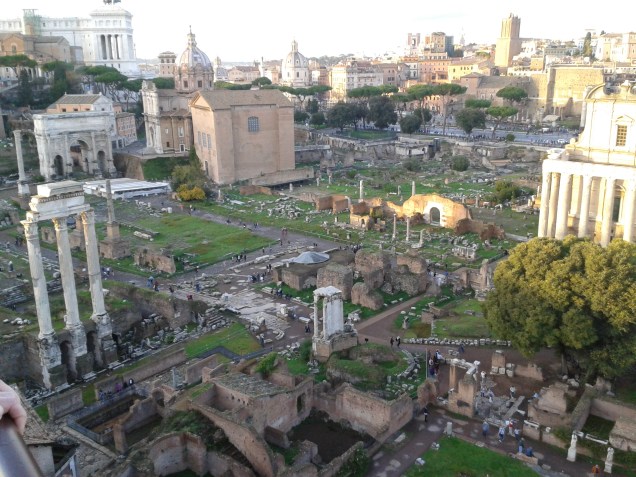
After visiting St. Peter, we’d had enough of churches. We decided to be pagans for the afternoon and visit the Roman Forum. I didn’t expect any easy answers to my doubts, and decided to just put them aside for a while.

2016-10-19-17-47-00

The shadows lengthened behind the broken columns in the Forum and we were almost ready to leave, when I noticed the entrance to a church at the bottom of the Palantine Hill. It was called Santa Maria d’Antiqua. It was built in the 6th century, and used until it was buried under rubble by an earthquake  in the 9th century. Hidden for more than a thousand years, it was re-discovered in 1900.

Although some of the wall frescoes had worn away in places, it was easy to imagine that almost every surface of this church had once been covered in paintings. Even after all these years, the colours were still bright and the style fresh and simple. There were paintings of the apostles, scenes from the Old Testament and the life of Jesus as well as the Virgin Mary carrying the infant Jesus. Some paintings depicted events from the lives of the saints and one showed several Popes, with a square rather than a round halo over the Pope who was alive at the time it was painted. On the floor lay the remains of an altar which had contained a recess for relics.

I left Santa Maria d’Antiqua quiet and humbled. This 6th century church contained everything which I had found objectionable in St Peter’s basilica: paintings and decoration, the Virgin Mary, saints, relics and even several Popes.

The destruction of images

If the Protestant narrative was right and the church had wandered away from its New Testament roots, then Jesus’ church hadn’t even lasted five centuries before going badly astray. I either had to accept this narrative, or accept the alternative that the 6th century Christians hadn’t fallen into grave error when they decorated their church with scenes from the Bible as well as pictures of saints and popes.

Other uncomfortable images sat in my mind as I turned over these thoughts. Earlier in our stay in Rome we came across an exhibition showing photographs of historical sites in the middle east before and after occupation by Islamic State. The earlier photos showed ancient temples and statues or the remains of old towns. More recent photos showed the same sites standing in ruins after being deliberately destroyed. The most disturbing photo showed a bearded young man, sane and respectable looking, at work systematically destroying an ancient statue.

As we left the exhibition, I expressed my indignation to my cradle Catholic husband. He was silent for a moment and then said, “You do realise that your Protestant ancestors did exactly the same thing to Catholic churches.”

He was right. In Scotland, very few ancient churches escaped the ravages of the Reformation. Arbroath Abbey and St Andrews Cathedral are now just broken walls with grass growing in the interior. I have stood inside the ruins and wistfully wondered what they looked like, before the angry young men, who were Scotland’s Reformers, smashed statues and altars, tore down the roof and encouraged the local population to use the walls as a source of building materials.

Perhaps Scotland’s churches were once as richly decorated as the churches in Rome.

Does God like bling?

If I am going to accept that the people who decorated the 6th century church in Santa Maria d’Antiqua were trying to give glory to God in the best way they knew, then I also have to accept the more modern Roman churches crammed with religious imagery.

2016-10-19-17-09-16

The Virgin Mary and child – Santa Maria d’Antiqua

I prefer the Byzantine art, with its flat faces and bright simple colours, to the paintings of more recent centuries. However, this is simply a matter of taste. Both ancient and more modern churches depicted the same kind of subject matter. My own taste may run towards the very simple, but I also have to admit that the plain little chapel I imagined after my visit to St Peter’s Basilica, looked very like the church in which I was brought up.

The conclusion I have reluctantly reached is that God does like bling. Or perhaps it isn’t so much that He likes bling, as that He understands our need for images and symbols. He also understands our need to seek Him through music, or words or paintings. Even these blog entries are a result of my own fumbling attempts to seek God through trying to express my thoughts.

In a time when very few people could read, paintings were an important way for them to learn about faith. Some of these paintings and images might be more to my taste than others, but they all represent a turning towards God, a seeking. No-one can possess God or know God fully in this life, and paintings, imperfect as they are, point to the Divine.

The visit to Rome was challenging. I may never be entirely comfortable in richly decorated churches. However, whenever I question whether God can also be there, I will remember the visit to Santa Maria d’Antiqua.

Purple is for Advent

20151129_120400

I’m reblogging this post from the first Advent after I became Catholic. Although I didn’t admit it at the time, I wrote this piece just after making the embarrassing mistake of picking up the wrong colour of Mass book. I didn’t realise that New Year and a new mass book begins at the start of Advent. The post still reflects what I’m trying to understand about Advent. I’ll put up another one with new thoughts in the next week or so.

When I became Catholic, I had heard of Lent and giving up chocolate in the weeks before Easter. It was a not entirely pleasant surprise to find out that Advent is also a time of self examination and penance when Catholics prepare to celebrate the birth of Christ.

The reformed church in which I grew up did not recognise Christmas as a religious festival. Some people did not celebrate Christmas at all, and others kept it as a purely commercial festival for the sake of the kids. Christmas for me was a time of quietly counting Christmas trees glimpsed through open curtains, delving into stockings, unwrapping presents from gaudy paper and over-indulging in food. Although I knew the story of Christ’s birth, I was more likely to hear it in July than at Christmas time.

The idea that the time leading up to Christmas is one of self-restraint as Catholics prepare to celebrate the birth of Christ, came as a bit of a shock. I find it hard to reconcile what is going on inside and outside the church at this time of year.

Outside, shops are full of tinsel and bright Christmas displays. I brave packed department stores and queues at checkouts and leave with heavy bags and an empty feeling that I have somehow missed the point. Harried mothers exchange notes on how much shopping there is still left to do. I feel the burden of Christmas as an annual commercial ritual, which becomes more costly every year.

Inside, the church is quiet, waiting, the only decoration is the four candles in the Advent wreath. Extra time has been set aside for the Sacrament of Reconciliation. The readings from the prophets talk about God’s mercy, a people being redeemed and returning from exile, streams flowing in the desert dryness. The cry of John the Baptist from the wilderness echoes down the years.

The priest wears purple, just as in Lent. I always thought that purple was a royal colour, a sign of wealth, more suited to celebration than penance. I wondered, why purple was used, and in the liturgical year book for England and Wales for 2013-2014, I found this beautiful explanation. For those who don’t know, as I didn’t until recently, a new liturgical year begins at the start of Advent.

The year begins in darkness a deep purple darkness where we long for light and the bright shimmer of a star is a sign of hope and life. In the Liturgical Year, purple or violet is a colour of longing, renewal and expectation: in Advent and Lent, at funerals or in the Sacrament of Penance, purple should speak to us of that which we long and yearn for: like a deer longs for running streams, so we yearn for the living God to come to us, to heal us, to be with us. Our purple is a sign of all we long for: the presence of Christ, the washing clean of all sin, the resurrection of the dead.

Purple is also a sign of kingship and majesty the One who comes, the One who heals, the One who raises the dead is himself the King who reigns from the cross….The Church and the liturgy should be waiting not quite there yet, just around the corner….Advent is the unfilled glass polished and made ready speaking in its emptiness of what is to fill it.

A new conversion story

20161115_074650

‘Night’s Bright Darkness’ is the story of the poet Sally Read’s conversion from atheism to Catholicism in nine brief months. It opens with a description of Sally as a young student nurse laying out a body for the first time. She doesn’t spare the reader the practical details of handling a dead body. When she had finished, the Irish nurse who was instructing her told her to open the window “to let his soul fly”. However, Sally was an atheist and the idea of the soul seemed like an anachronism.

Her life was not without compassion. She trained to become a psychiatric nurse in order to help the weak and vulnerable. She sought for some spark of personality left in patients whose minds had gone, leaving behind the living husk of the body. When her father died, she didn’t allow herself any delusions. She remained firm in her belief that there was no transcendent being, and that all that was left of her father was his ashes. During this difficult period, her atheist convictions almost pushed her into the void. She describes sitting down one day and saying, “This is hell.”

God did not step in at that point. However, he caught up with her years later when she was living in Italy with her husband and small daughter. Research for a book she was working on, brought her into contact with a priest. ‘Night’s Bright Darkness’ tells the story of how from that small opening her life and convictions were turned upside down.

Some things I like about this book

‘Night’s Bright Darkness’ is not always a comfortable or an easy read, but it is a beautiful book. True to her poetic calling, Sally Read doesn’t waste words. Each passage counts. She gives vivid, succinct descriptions of her life in London and Italy. The story is fast-paced as the fire of her conversion rapidly burns through her previous liberal and atheist beliefs.

At times she grapples with describing experiences which go beyond the logic of the five senses. She describes grace “as if I had been blindly rifling a thick black backdrop before I unexpectedly put a hand through where the two halves of the fabric met.”

The book is not written in strict chronological order. The author has divided it into chapters on the Father, the Spirit, the Son, the Church, the Mother and the Mystery. Each contains relevant reflections on her life before and after she became Catholic. She mentions things which I recognise from my own journey towards the church, but hadn’t really thought about. Writing about her first confession, she says, “The Catholic Church, which I had always seen as wrapped in barbed wire and brambles, was as yielding, accommodating and non-judgemental as a mother.”

Sally Read does not shy away from describing the painful adjustments her family had to make in order to accept not just her new faith, but the fact that she had also changed as a person. I appreciate her frankness in writing about things which are probably experienced by many converts. Conversion affected all of my relationships, and it took some time before I and the others in my life could accept these changes.

This book fills a gap

My own conversion was like a deep, strong current pulling me seemingly unstoppably to a place I had just about sworn I would never go. During this period, I trawled the internet devouring conversion stories in the hope that they would help me understand what was happening.

Most of the stories I found were written by North Americans. Almost all of them described the painful process by which Evangelical Protestants question their church and eventually, despite all their initial objections, turn to the Catholic church for answers. These stories were important. They helped me to understand and answer the questions I had about Catholic faith as someone coming from a Protestant background.

However, I longed to find a conversion story from a culture closer to my own. I also carried the burden of turning away from the church, mocking belief and wanting nothing to do with organised religion.

None of the conversion stories I read during this period described the process of going from almost hating churches to a deep hunger for the Eucharist. However, ‘Night’s Bright Darkness’ fills this gap. It describes how God can turn a life in a completely different direction and replace atheism with the peace of his presence.

It’s important to record these mysteries because the fire of conversion eventually cools. Sally Read says, “We have to remember…, because these feelings, so right and pure, get muddled and muddied in the daily tramp of life and all its obligations. History disappears down the long line of dates; the supernatural recedes into some distant sky.” I appreciate this story, because at a time of doubt and darkness, it has helped me to remember the sure sense of God’s presence which drew me into the church.

Towards the end of the book, Sally Read describes her struggles to bear witness to her faith as a mother, as a writer and translator, as a parishioner organising adoration, and as someone whose love for her faith spills over into conversations. As she says in the last paragraph, this is an unfinished story about an ongoing journey. She writes with insight, honesty and passion, and I hope that she will share more in future books.

No-one has a monopoly on Christ


20160924_190921-2

Last week the Pope visited the Lutheran church in Sweden in order to mark the 500th anniversary of the Reformation.

It might seem strange for a Catholic Pope to commemorate in any positive way an event which caused a seemingly irreconcilable split in the Christian church. However, Pope Francis said, “With gratitude we acknowledge that the Reformation helped give greater centrality to Sacred Scripture in the Church’s life.”

When I first became Catholic, I might have felt threatened by this. I wanted to assert my Catholic identity by kicking against the church I had come from. There was a very great temptation to see everything Catholic as good, and what I had left behind in the Protestant church as bad or at least inadequate.

However, I’ve come to recognise that a part of me will always be Protestant. By becoming Catholic, I didn’t change my personality or my family background. A priest who is a Protestant convert told me to treasure this part of me, because it would make a positive contribution to the church. I didn’t want to listen to him at first. However, I now recognise the wisdom of what he said.

Christ broke down barriers

If Christ was here today, I am sure that he wouldn’t stick to one church and ignore the rest. He would reach out to all sorts of people in many different kinds of churches. He would also hang out with people who wouldn’t dream of darkening the door of a church. Christ would be found in pubs and betting shops and at street corners. He would talk to homeless people in doorways and lost and lonely people in mental hospitals and care homes.

During his ministry, the sharp end of his tongue most often fell on the Pharisees and Sadducees, the religious leaders of his day. He criticised them for burdening people with rules. In the stories he told, the poor and dispossessed are invited to a wedding feast and a father gives the son who squandered his fortune a lavish welcome.

Jesus was someone who tipped over conventions and broke down barriers. He healed on the Sabbath day. He mixed with women. Not only that, he mixed with women from other religious backgrounds. His disciples were astonished to find him conversing with a Samaritan woman. He healed the daughter of a Canaanite woman and the servant of one of the Roman soldiers who was occupying Palestine.

Five hundred years ago, part of the Christian church branched away. Since then it has divided many times. I was brought up in a church which had split at least four times since the Reformation. There are so many differences in interpretation of the Bible and forms of worship that the differences between churches seem irreconcilable. However, what is impossible in a human level is not impossible for God. Perhaps, beneath it all, there is an underlying unity which we miss because we are so concentrated on the surface details.

Recognising the other

What I am sure about, is that Christ is not constrained by our barriers. He sees what we cannot. In an article in the Catholic newspaper, The Tablet, the Lutheran archbishop emeritus, Anders Wejryd, said of the Pope’s visit to Sweden, “When it comes to ecumenism, the first stage is diplomacy. That you acknowledge that the other is there and that the other church is more or less a real church, even if you don’t share all of its opinions.”

He describes what to me is a Christ-like attitude. At a time when politics seems to be increasingly about divisions and Us against Them, it is advice which could be applied not just to religious differences, but to our daily life. Barriers will only be broken down when we learn to see others as they really are.

Mary as Christ’s mother

20160611_185620

Marian devotion was my biggest sticking point when thinking about becoming Catholic. I had no instinct for it. Eventually I decided that since I was convinced about other aspects of Catholic faith, I would trust the church on this one.

Even before I was received into the church, I felt drawn to praying the Rosary. I wouldn’t be without it now. Meditating on the life of Jesus and Mary in this way often brings me peace when nothing else can.

However, I still puzzle over devotion to Mary, the mother of Jesus. Our priest says that people fall into two errors when it comes to devotion to Mary: either they show too much devotion, or not enough. But what is enough? What role does she play? How does she fit into the picture? When praying the Rosary, she sometimes emerges as a concrete, human figure, but at other times she can seem elusive. Most of the time I feel more connected to my favourite saints than I do to Mary, the mother of Christ.

A dream

Recently I had a dream which helped me understand Mary’s role a little better. It was the kind of vivid dream which wakes you in the middle of the night and keeps sleep away for a while. In this dream, I was in a modern-looking church in which benches fanned out in a semi-circle from the altar. I felt apprehensive as I looked around. Many of my relatives and friends were spread out around the church and I knew that they would take a dim view of a Catholic Mass.

When, the priest began, I was on edge, hoping that the Protestant visitors weren’t feeling too out of place. It turned out to be one of those days when a hymn was sung in praise of the Virgin Mary. I felt like sinking through the floor of the church as I imagined the reactions of my Protestant friends. Why on earth did they had to turn up on a day when particular devotion was shown to the Virgin Mary? In my experience, Catholics are much more likely to sing a hymn in praise of the Eucharist than in praise of Mary or the saints.

 At this point, the Protestant visitors began protesting. I can’t remember everything that was said, but they argued strongly against Marian devotion. One of my relatives delivered the final blow. He stood up and declared that Catholics give Mary an equal position to Christ. They claim, he said, that she is co-mediatrix, an equal partner in our salvation.

My faith tottered. I wondered if I was deeply offending God by having any devotion at all to the Virgin Mary. I knew that I had to stand up and say something, but I had no idea what. I got to my feet and to my surprise words came to me. I said that Mary was as much a partner in Jesus’ work of salvation, as my mother was in my getting a degree.

An Analogy

These few words were enough. I awoke. It was dark and I was in my own bed, but the dream still felt very present. When I thought about it, it seemed that I had been given a good analogy.

My mother never had the chance to get a college or university education. She didn’t understand my degree subject, and I enjoyed teasing her by coming out with strange facts which she had trouble accepting. However, without her help, I would never have got a degree. She gave birth to me and brought me up to have a respect for education and knowledge.

My parents provided financial support. My Mum fed me up at half-term and sent me off again with packages of food. She didn’t bat an eyelid when I turned up with some of my strange new friends from university and told her that they needed a meal or a bed for the night. When I was lonely or things were difficult, I called her from a red telephone box in the rain. At the time I took my mother for granted, but now that I’m a mother myself, I appreciate her a lot more. Without her support, I wouldn’t have achieved what I did.

There is a parallel with the role of Mary in God’s plan of salvation. Christ, her son, did it all, and yet she was an essential part of God’s plan. She gave birth to Christ, and brought him up to love others and to love God. She encouraged and supported him, and even followed him to the foot of the cross.

Christ was fully human and yet fully divine. Like other human beings, he didn’t come from no-where. He had a family and that family helped to create the circumstances in which he could carry out his ministry and his work of salvation. Perhaps part of the reason we show devotion to his mother, is because he wants us to join him in appreciating the part she played in his life.

That dreaded word conversion

20160605_175919

I remember being totally confused as a little girl, when I heard my uncle talking about a barn he had converted. Had the barn undergone some kind of religious experience?

I left the Protestant church I was brought up in and searched for some alternative belief system or set of experiences which would bring meaning to my  life. From time to time, I came across people who convinced me that I needed to be converted. It never came to anything. A few days later, after the euphoria died down, I remained the same messed-up self that I was before.

After trying it several times, I gave up and shrunk away from anything which smacked of conversion. I wouldn’t have said that my life wasn’t in need of improvement, but I didn’t feel that I could change according to a formula. I stopped going to church altogether, and would have described myself as an agnostic who leant towards a belief in God.

Conversion is a very personal thing. You can’t force it on anyone. A human being might look at the barn and decide that it needs to be converted into a studio flat. From the cow’s point of view, however, conversion would be a disaster. It would turn the barn into something totally useless.

Caught in the end

For various reasons, I started attending the Catholic church. Despite my aversion to conversion, I was caught in the end.  I can remember exactly where I was sitting in the church and what the priest was saying. He was telling a story about someone who asked him if he expected to make any conversions to Catholicism. He paused, and I waited, knowing that if he told us that he expected to make converts, then I would be out of that church as fast as my legs could carry me, and probably never come back. I hated the trapped feeling I got when someone didn’t accept me as I was, but just saw me as a potential proselyte.

“I leave conversions to God”, was what the priest actually said. Instead of feeling relief – I was let off the hook, wasn’t I? – I experienced disappointment. Until that moment, I had not realised that I actually wanted to become Catholic. I found out that I actually wanted someone to convince me that there were good reasons for me to convert.

The thought was so daring and so strange for someone brought up strict Protestant, that I didn’t know what to do with it. I hugged it to myself like a joyful secret, reasoning that if it was from me, it would fade away, but if it was from God then I wouldn’t be able to get rid of it. After six months, the thought still hadn’t disappeared and I realised that I would have to do something about it.

No-one cheers you on

On my journey to becoming a Catholic, I was by turns frustrated, disappointed and relieved that I received little encouragement. Catholic friends were politely interested. The priest made himself available to discuss things, but left it up to me to decide if I wanted to return with more questions.

After making a decision to be received into the church, things seemed to get even harder. I wouldn’t go quite so far as to say that I was so discouraged, but it felt disappointing. If I was planning on joining a Protestant church, I would have been the centre of attention. People would have been solicitously cooing and clucking over me, like a newborn baby. As a wannabee Catholic, I felt that I had to give each door a hard shove before it opened.

I realise now, of course, that people were giving me space. They didn’t want to put me under any kind of pressure and were keeping their distance, so that I could back away with dignity if I felt it wasn’t for me. They knew that if what was pulling me into the church was from God, then it wouldn’t be snuffed out by a draught of cold air.

That loaded word conversion

A while ago, I took part in a survey of religious converts, to or from any kind of religion, being carried out by Leeds Beckett University. If anyone is interested, the survey is open until 30th June 2016. Their initial findings show that about two thirds of converts experience a ‘light bulb’ moment when they realise that they have to change their belief system, just as I did. However, this moment of decision doesn’t come out of the blue, but after extensive reading about the new belief system.

So where does that leave me with that loaded word conversion? It speaks of dusty things from the past being ripped out and replaced with squeaky clean surfaces, sparkling bathrooms and smooth floors. I couldn’t live up to that image, and in the end, didn’t want to even try.

A change of direction may creep up on us gradually. In my case, there was a definite moment, an instant, in which I recognised that change of direction. However, a change of heart is a slow, lifelong process. I have to be patient with himself.


Protestant or Catholic?

sunset

Am I Protestant or Catholic? I’ve been received into the Catholic church, but as far as identity goes, this isn’t an easy question to answer. Over the past few weeks I’ve had exhausting dreams in which I’ve been attending Mass, and then rushing off to go to one or other of the Protestant churches I attended as a child.

When I decided to become Catholic, my husband, who was raised Catholic, warned me that I would always remain Protestant. At the time, I dismissed his comment, because I had been through huge changes in my thinking and beliefs. I felt that I was already more Catholic than Protestant.

Now that all the excitement and euphoria and challenge and worry of converting has died down, I realise that he made a very astute comment. I was brought up steeped in the Highland Protestant tradition. From my mannerisms and background, people assume that I am Protestant, and in a way they are right. I can’t change the fact that my Protestant background is woven into me, a fundamental part of my identity.

I have chosen to become Catholic, or perhaps it is better to say that I was invited to become Catholic; the idea certainly didn’t originate with me. After making a long hard journey into the church, it is painful to realise that Catholics will always spot me as someone who wasn’t brought up in their tradition. Sometimes I feel as if I am going around with a label pinned to my back which reads ‘Brought up Protestant’. Not only that, people in the know can often work out, after a short conversation, exactly which flavour of Scottish Protestant.

Where am I in all this, caught between two traditions and not really belonging in either? Before I was received into the church, a priest told me that I would always have my Protestant identity. He said that becoming Catholic was like adding another layer of clothing on top of the Protestant layer on which was already there. He told me that I didn’t need to lose my Protestant identity, or try to distance myself from it. His words gave me comfort at a time when I was worried that I was betraying the people who had loved me and brought me up and taught me to worship God in a particular kind of way.

I understand better now that I can’t and shouldn’t try to remove that Protestant layer, even though it can at times feel so deep and strong that I wonder if I really am in any way Catholic. In Mass recently, I had an image of the Protestant part of me as being like a thick, deep layer of soil. Into that grows a Catholic root, long and strong enough to go right through the soil, down to the core of my being, the quiet place where God speaks and identity no longer matters.

I need the soil to nourish the plant, as well as the plant to bring life to the soil.

So, am I Protestant, or am I Catholic? The best answer I can give is that I am both, but that I am a practising Catholic. That is confusing and difficult for me, and perhaps also for other people, but I hope that God works in the pain and the discomfort of being neither completely one thing or the other.

Schroedinger’s cat attempts to go to church

20160411_163921

I recently faced a dilemma which most converts come across at one time or other: What do you do on Sunday when you are visiting your non-Catholic relatives? There were three possible options:

Option One – attend the Protestant church with my parents

Because I more or less developed an allergic reaction to any form of organised religion (see Don’t go to church), this was a sticky option. I had pointedly avoided my parents’ church for years. I wondered if I should go to show respect for their beliefs, and to make the point that I have changed. Before I announced that I was becoming Catholic, a request to attend my parents’ church would have been met with unreserved delight, and hope that I was finally seeing the light. However, nowadays it could potentially cause a lot of embarrassment. I had no idea what I would say if some well-meaning person turned to me after the service and asked, “Which church are you going to these days?”

Option Two – attend Sunday Mass at the local Catholic church

I grew up near this church. My friends and I dared each other to run past the gates, screaming in terror. A few years later, I considered it a normal part of life that the boys from our school would beat up the boys from their school. I was secretly proud that the boys from our school won most of the fights, or so they said.

When I walked into the church to light a candle, I felt uncomfortable almost to the point of feeling sick. It was the second hardest thing I ever did after telling my parents that I was going to become Catholic.

Option 3 – don’t go to church at all

A friend of mine, who is also a convert, gently pointed out that it was possible to just do nothing and not go anywhere. I didn’t find this option very attractive, because it seemed like reverting to the default position I had held through all the long years of agnosticism. I was afraid of disappointing God by just doing nothing.

Decisions

I tried to pray, and ask which choice would lead me a little further along a path of peace and reconciliation. However, I received no clear answer. All through Saturday, and even on Sunday morning, I was as undetermined as Schroedinger’s famous cat, whom Terry Pratchett said could be dead, alive or bloody furious. I was in a superposition of states; I simply did not know what to do.

Shortly before I would have to go out, if I wanted to make it to any kind of religious service, I realised that I was in a state of such tension, that I would become physically ill if I tried to attend church. I fell back to default position 3 with a bump. I wasn’t going anywhere, and the relief unwound at least five knots in my stomach.

I worried that I had let God down and disappointed Him. Doubts snapped at my heels like yapping terriers. Why on earth did I have to rock the boat by becoming Catholic? Why couldn’t I have just shut up and put up, and remained in the Protestant church, even though I was never really at home there, and towards the end felt pretty miserable. Perhaps I was meant to feel miserable.

On Monday morning, seeking some kind of peace or at least a feeling of resolution, I set out on a long walk, which I timed to coincide with Mass. When I arrived at the Catholic church, about forty elderly people were already there saying morning prayer beforehand. I didn’t have a Missal and I didn’t catch all the words, but what I heard was enough. The Psalms and Gospel verses reaffirmed my faith. I was participating in something which went far beyond my troubles. I could only see a few dozen people with greying hair, some of whom very obviously had their own physical ailments, but these prayers were being said in churches across the world. This dark, echoing, rather ugly church seemed in some mysterious way to graze the edge of something much, much bigger. I felt still and safe in what had once been the heart of the enemy.

After Mass, I had an image of myself as a tiny, frail bird. In my mind’s eye, it was bright yellow, like a canary, but it couldn’t have been a canary, because I can’t sing for toffee. I imagined that Christ was holding the tiny bird in His hands and gently protecting it, because it was too small and weak to fly far.

I felt that He was gently reproaching me for my contortions, when I tried to stretch tiny wings and be in two places at once. He knew that Option 3 is the only one I can manage right now.

He is in both places, but I can only be in one. Someday, when I am strong enough and whole enough, He may send me out to flit between the two places, but it will be a thing of lightness and joy, and not a fearful obligation. I will know within myself when it is right.

Lent …. again

20160207_205528

Just when there is a stretch in the days, and the wind dies down and the sun casts a pale shadow through the cloud, Father K stands up at the end of Mass, waves an envelope with the SCIAF collection box, and reminds us that Lent begins on Wednesday.

What, Lent? Already? My health hasn’t been great recently, so I haven’t indulged in coffee or chocolate for a while. Now that my stomach has finally settled down, I find out that there are only a few days left to enjoy it.

Why, oh why, oh why, did I join a church which has an annual six week period of penance? Because I had to, is the answer. I’m not talking about external pressure, but about the still, small voice inside, which said that this was the way I must go. I might not always like it, or feel like doing it, and I might moan about it, but I have to go on.

What I used to think about Lent

As a Protestant, I had very vague ideas about Lent. I knew that it had something to do with Pancake Tuesday, and using up all your eggs. However, I thought that it was a sort of medieval thing which people didn’t do any more.

I got a bit of a shock some years ago when my husband announced that it was Lent, and that it would be a good idea for us all to give up chocolate until Easter.

My angry reaction was out of all proportion to the small sacrifice involved. I enjoyed my wee nibble of chocolate now and then and no-one, certainly not some stuffy, traditional church, was going to dictate if and when I would give it up.

However, I knew that small children will not give up chocolate biscuits, if they see their mother eating them, and so I went along with it. I started without much good grace, but soon realised that giving up something made me conscious of others who had much less than I had. It made sense. Perhaps this was the first step on a slippery slope which eventually brought me into the Catholic church.

How things are now

Even though I’ve done Lent a few times, it doesn’t get any easier. I’m a bit apprehensive. Last year was difficult. Without even trying to turn up at church in a penitent mood, I found that I was quite affected by Lent and became very conscious of my own failings and inadequacies.

In a world where resources are so unevenly distributed, and where foodbank collection points have become a permanent feature in the local supermarket, I hope that doing without small luxuries for a while, will help me to be grateful for what I have, and remember others who don’t have enough.

Lent is mirrors the forty days Jesus spent in the desert fasting and praying. When I think of Lent, I remember that Christ gave up far more than I can ever understand just to take on human form. I’m sure that he enjoyed his human life. He started his public ministry at a wedding feast, after all. However, he willingly gave up his life.

I’ve just used up all the cocoa in the house. I’m still not sure what this year’s Lent will involve, but I think that it may require an internet diet. If I write this blog, it might just be to put up quotes I’ve found useful. Best wishes for the Lenten season.