Easter thoughts

Easter was a joyful day.

I was away from home and I went to an early morning Mass in an unfamiliar church. There was no fancy music to pull at my emotions and the homily was delivered by a middle-aged priest with a flat, level voice. However, I was moved to tears of happiness.

Sometimes I feel nothing when I go to Mass and at other times, often when I just go without expecting anything, I feel very emotional as if something is working in me which I can’t grasp or understand. It is hard to put what happened into words, but I will try.

I live in a time of continual change. My wee country of Scotland is going through a time of uncertainty. It is like one of the smaller Caledonian MacBrayne (CalMac) ferries which take shuttle people and cars and food and newspapers to and from the islands. At the moment, it is so stormy that everyone on the boat is either vomiting or trying very hard not to vomit. Meanwhile the Calmac staff, whose stomachs are hardened by many choppy crossings, go around handing out paper bags. They do their best to clean up sick patches on the upholstery with paper tissues and smelly sprays.

800px-Mull-26_(9041261371)

By Gerry Zambonini (Mull-26  Uploaded by Vclaw) [CC BY-SA 2.0 (http://creativecommons.org/licenses/by-sa/2.0)%5D, via Wikimedia Commons


The UK is like a creaky ship from the heyday of the empire, built in the style of the Queen Mary with luxury quarters for the first class and less salubrious third class cabins in the bowels of the ship. It sails straight through the waves, but we’re all afraid it might be about to hit an iceberg. Things change every day. Yesterday a general election was announced just two years after the last one.

As for myself, I am experiencing uncertainty about work and the health of a family member. I see myself as a little boat, perhaps one of the wooden corracles used on the west coast of Ireland. I have left one shore far behind. It is out of sight, no longer even a faint blue line on the horizon, and the next stretch of land is not yet visible. In every direction, I see only sea. Sometimes it is pleasant to be out on the sea, but at other times, the waves are large and threaten to swamp my little boat.

Just as I can’t see land, I can’t see who is steering and guiding my little coracle. However, Easter Sunday gives me hope that Christ is risen, not defeated by death, and that He is there even if I can’t see Him.

I almost felt Christ’s love, not just for me but for every single person in that church, however, ordinary and insignificant we seemed to be. Easter gave me hope that God loves me. I don’t need to struggle on the treadmill of trying to be young enough and attractive enough and strong enough and rich enough and wise enough and important enough to gain the approval of others.

I can’t earn God’s love. He offers it freely despite my faults and failures. Believing in God’s love is an an ongoing challenge. I’ll say more about that in the next post.
A convert visits Rome Part 2

A visit to Santa Maria d’ Antiqua

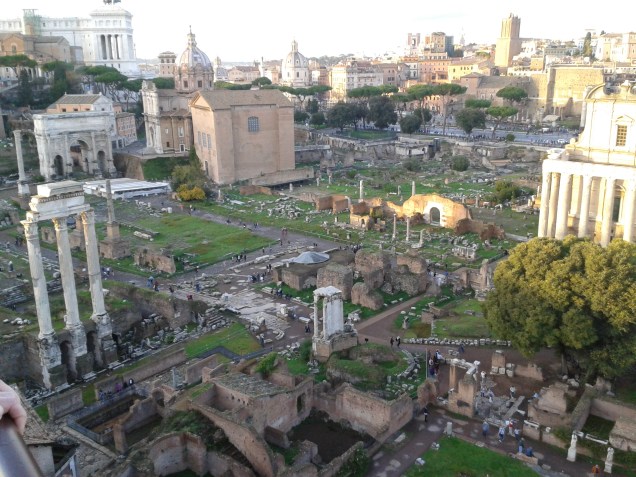
After visiting St. Peter, we’d had enough of churches. We decided to be pagans for the afternoon and visit the Roman Forum. I didn’t expect any easy answers to my doubts, and decided to just put them aside for a while.

2016-10-19-17-47-00

The shadows lengthened behind the broken columns in the Forum and we were almost ready to leave, when I noticed the entrance to a church at the bottom of the Palantine Hill. It was called Santa Maria d’Antiqua. It was built in the 6th century, and used until it was buried under rubble by an earthquake  in the 9th century. Hidden for more than a thousand years, it was re-discovered in 1900.

Although some of the wall frescoes had worn away in places, it was easy to imagine that almost every surface of this church had once been covered in paintings. Even after all these years, the colours were still bright and the style fresh and simple. There were paintings of the apostles, scenes from the Old Testament and the life of Jesus as well as the Virgin Mary carrying the infant Jesus. Some paintings depicted events from the lives of the saints and one showed several Popes, with a square rather than a round halo over the Pope who was alive at the time it was painted. On the floor lay the remains of an altar which had contained a recess for relics.

I left Santa Maria d’Antiqua quiet and humbled. This 6th century church contained everything which I had found objectionable in St Peter’s basilica: paintings and decoration, the Virgin Mary, saints, relics and even several Popes.

The destruction of images

If the Protestant narrative was right and the church had wandered away from its New Testament roots, then Jesus’ church hadn’t even lasted five centuries before going badly astray. I either had to accept this narrative, or accept the alternative that the 6th century Christians hadn’t fallen into grave error when they decorated their church with scenes from the Bible as well as pictures of saints and popes.

Other uncomfortable images sat in my mind as I turned over these thoughts. Earlier in our stay in Rome we came across an exhibition showing photographs of historical sites in the middle east before and after occupation by Islamic State. The earlier photos showed ancient temples and statues or the remains of old towns. More recent photos showed the same sites standing in ruins after being deliberately destroyed. The most disturbing photo showed a bearded young man, sane and respectable looking, at work systematically destroying an ancient statue.

As we left the exhibition, I expressed my indignation to my cradle Catholic husband. He was silent for a moment and then said, “You do realise that your Protestant ancestors did exactly the same thing to Catholic churches.”

He was right. In Scotland, very few ancient churches escaped the ravages of the Reformation. Arbroath Abbey and St Andrews Cathedral are now just broken walls with grass growing in the interior. I have stood inside the ruins and wistfully wondered what they looked like, before the angry young men, who were Scotland’s Reformers, smashed statues and altars, tore down the roof and encouraged the local population to use the walls as a source of building materials.

Perhaps Scotland’s churches were once as richly decorated as the churches in Rome.

Does God like bling?

If I am going to accept that the people who decorated the 6th century church in Santa Maria d’Antiqua were trying to give glory to God in the best way they knew, then I also have to accept the more modern Roman churches crammed with religious imagery.

2016-10-19-17-09-16

The Virgin Mary and child – Santa Maria d’Antiqua

I prefer the Byzantine art, with its flat faces and bright simple colours, to the paintings of more recent centuries. However, this is simply a matter of taste. Both ancient and more modern churches depicted the same kind of subject matter. My own taste may run towards the very simple, but I also have to admit that the plain little chapel I imagined after my visit to St Peter’s Basilica, looked very like the church in which I was brought up.

The conclusion I have reluctantly reached is that God does like bling. Or perhaps it isn’t so much that He likes bling, as that He understands our need for images and symbols. He also understands our need to seek Him through music, or words or paintings. Even these blog entries are a result of my own fumbling attempts to seek God through trying to express my thoughts.

In a time when very few people could read, paintings were an important way for them to learn about faith. Some of these paintings and images might be more to my taste than others, but they all represent a turning towards God, a seeking. No-one can possess God or know God fully in this life, and paintings, imperfect as they are, point to the Divine.

The visit to Rome was challenging. I may never be entirely comfortable in richly decorated churches. However, whenever I question whether God can also be there, I will remember the visit to Santa Maria d’Antiqua.

A convert visits Rome. Part 1

Before I became Catholic Rome was probably bottom of my list of European cities which I wanted to visit, but things change and I found myself wanting to visit Rome, and then making the opportunity to do so.

I went loaded with expectations. Surely I would feel something profound when I visited the church built on the site of St Peter’s martyrdom. I liked the boldness of going to Rome, and hoped to integrate myself better into this strange thing called the Catholic church. I also hoped for peace and some of these quiet moments when I would feel, just for an instant, the touch of God.

2016-10-17-18-28-18
Trevi Fountain


I loved Rome: the coffee, the food, the piazzas and fountains, the narrow alleys with antique shops, and the colourful streets in Trastevere, The visit was rich in experience. However, as far as religion went, I found turbulence and challenge.

On the first evening in Rome, when it was almost dark outside, we wandered into a church near the Trevi fountain. In contrast to the brightly-lit white marble fountain, the church was like a dark tent of deep red and blue, lit by candles and a few electric lights. The richly-decorated side chapels receded into darkness. A mass was underway and near the front of the church, women in dark clothes, some wearing mantillas, recited responses in Italian. Nothing looked or sounded familiar. I had the feeling that I had stumbled upon the rituals of a totally foreign religion.

Even when I visited churches in the daytime, I was overwhelmed by the amount of religious imagery: scenes from the Bible, saints, martyrdoms, or simply decoration covering every available surface.

I was brought up in an ultra-reformed branch of the church. No religious image or symbol was permitted either in the church or in our home. I remember being punished for decorating my Bible with a cross. Given my background, it probably isn’t surprising that all this religious imagery was a real challenge.

A visit to St Peter’s

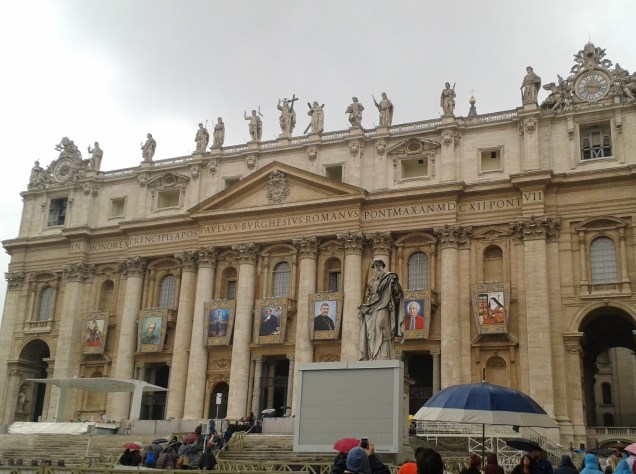
St. Peter’s, from which I had hoped so much, was too much for me. With the long nave, huge marble columns, more than life-size figures of past Popes and the large, ugly canopy over the main altar, it felt large and draughty and masculine. I stared into the side chapels and found one containing, quite incredibly, relics from the 4th century saint St John Chrysostom. I stared at the painted cupula above, trying to make sense of things, when someone pushed my arm. All they wanted to do was ask if I would take a photo, but I was feeling so confused and overwhelmed that this small nudge pushed me to tears. Fortunately, my husband was on hand to take the photo and exchange small talk.

2016-10-18-15-08-43-2

I went into a side chapel set aside for prayer and adoration. However, it was covered in so much gold paint and decoration that I felt as if I was inside a jewelled box. Even though I was surrounded by people kneeling in prayer, I had no sense that God was there. I asked God where He was in all of this, but the only thing I took away was a question, “Does God really like all this bling?”

A challenge to faith

I left St. Peter’s with some very uncomfortable questions. Why all these paintings and opulence? Why memorials to saints and past Popes? Why this devotion to saints and relics, and since I was questioning other things, I might as well ask whether the church needed devotion to the Virgin Mary? I yearned for a tiny chapel with white-washed walls, which was totally free of images, and wondered why the Catholic church couldn’t adopt this plan for its interior decoration.

The narrative I’d learnt as a Protestant went something like this: when Jesus founded the church, it was pure and simple and good. However, somewhere along the way (although it wasn’t quite defined when), the church acquired unnecessary and even idolatrous practices, such as confession and praying to the saints and the Virgin Mary. The Reformation came and allowed Christians to return to the simple pure form of worship which had existed in the early church.

After visiting St. Peter’s, I felt the attraction and the persuasiveness of this argument. Perhaps the Catholic church had drifted far away from what Christ intended. Maybe I had made a huge error joining it.

To stop this post becoming too long. I’ll describe in the next one how I received answers to these questions.

The sacrament

20160608_131519

I want to go to Mass. I don’t want to go.

I am afraid of my impossible expectations. Nothing ever turns out the way I think it should. I fear this unreachable God. I am overwhelmed by the distance between us. I worry that I will take the Eucharist and feel nothing. Most of all, I fear discovering in my deepest, inner self, that there is no God.

I fear longing, and I fear not longing.

I keep my head down, trying to dodge the voice which asks what business I have attending Catholic Mass? I was brought up a doughty Protestant. Who am I kidding that I’ll ever make a good Catholic? My life doesn’t stand scrutiny. If you hold it to the light like an old garment, all you will see is holes.  

At the last moment, when there is really almost no time left, I know I have to go.

I scuttle in at the tail end of the Gloria. Another failure. I am crushed inside.

I tell God about the things which are tearing me apart. I try to turn towards Him, an imperfect, scratched piece of metal, such a dull reflection of His light.

We say Holy, Holy, Holy, Lord God of Hosts. I bend to my knees in relief, hide my face and my tears in my hands, and say, God do with me what you will.

And then I go up for that tiny sliver of bread, a flat little wafer handed over with compassion. I look at it in my palm, hardly bigger than a thumbnail. I can’t take in the thought that Jesus lies there. I really can’t believe it. All I can do is take, eat, kneel and hope and pray that I will experience what I cannot comprehend.

I pray for mercy. I ask that Jesus will come into the hovel of my soul and stay a little while, because I am too weak and small and poor to do anything myself.

I leave the church, forcing a smile and exchanging a few words. I hold things together long enough to take myself off to a quiet place, and then something cracks. Walls, barriers, defences crumble. Tears flow again. I am breaking up inside and I can hardly bear it. There is darkness in front of me. I am afraid to go forward. I can’t go back.

All I can say is, Sweet Jesus, I feel as if you have taken hold of my heart and pulled it out through my mouth. I have nothing left. You have taken it all. You have it all. If you want me to love others, you will have to do it through me, because I am nothing. I have no strength on my own.

We shall not be overcome

20151224_142018

In the last week or so, I have been trying to hold onto St Therese’s image of clinging onto God. When asked to help train novices, she wrote that if she had tried to do the work in her own strength, she would have given up right away.

Returning to work

Recently I have been asking myself what it means to do things in God’s strength. The difficulties I face are so great that I sometimes wonder how I am going to keep going at all. Over the past year or so, I have been trying to start working again.

Giving birth to children, trying to juggle work and childcare, and finally giving up my career and ambitions so that I could bring up my children were huge challenges at the time. However, trying to return to the relentless routine of the workplace is also a difficult period in a woman’s life which, I think, goes largely unrecognised. One minute you are at the beck and call of small people, their needs and sicknesses, and the next you are supposed to be punctual, scrubbed clean, well-ironed and thinking about nothing but professional problems.

It is difficult enough if you are slotting back into the job you were doing before you went on maternity leave (I’ve done that too). However, if your old job is long gone and you have to retrain to do a new one, starting on the very bottom rung, the path ahead can seem impossibly difficult.

Over the last while, I have felt as if I am trying to climb Mount Everest with several kids strapped to my back and without proper equipment. I lumber slowly forwards while lithe young graduates gallop past like gazelles in super-dry clothing with tiny, ultra-lite backpacks strapped to their backs.

A long, long time ago, it feels as if it happened to someone else in a story, although it was actually not much more than a year back, I prayed about whether I should try to do this job. It felt like the right thing to do. In fact, it was the only choice which brought me peace.

It all feels too much

Now that I’m in the thick of it, I just feel confused and exhausted. The job is tiring and there’s so much to learn. Over the last week, the kids and I have all go sick, and what do you do when you have to work and there is no wider family or in-laws or out-laws (to borrow a phrase from one of my in-laws) to help out?

Sometimes it all feels too much. I have conversations with God along the lines of, “Are You sure you’ve got the right person, here? It seems like there’s so many other people out there who could do this job better than me. I keep making mistakes. Some days almost feel like an unmitigated disaster. I’m asking You for help, but all these obstacles appear in the way, including the ones made by my own inexperience.”

Keeping going

Two things keep me going. One is Gerard W. Hughe’s advice based on Ignatian spirituality. He says that in a time of desolation, you should never go back on a decision made in a time of consolation. If I’m honest with myself, I can look back on times when I did enjoy doing this work, and when I felt that I had confirmation that I was on the right path.

The other thing which keeps me putting one foot in front of the other, is the thought that it wouldn’t be faith, and I probably wouldn’t be learning much, if God magically cleared every obstacle out of my path.

I often think of the words of Julian of Norwich, the medieval anchoress who lived alone in a cell attached to St Julian’s church in Norwich.

He did not say, ‘You shall not be tempest-tossed, you shall not be work-weary, you shall not be discomforted.’ But he said, ‘You shall not be overcome.’ God wants us to heed these words so that we shall always be strong in trust, both in sorrow and in joy.

A sense of peace

 20160912_195335-2

Peace comes up many times in the Mass, from the opening line of the Gloria, “Glory to God in the highest, and on earth peace to people of good will”, to the priest’s words just before the sign of peace, “May the peace of God be with you always”, and the peoples’ reply, “And with your spirit”, and to the prayer just before communion, “Lamb of God, you take away the sins of the world. Grant us peace.”

Right at the very end, we are sent away with the words, “Go in peace, glorifying the Lord by your life.”

Consolation

A number of years ago, the illness of a close family member caused me great anxiety, and my search for some way of dealing with this pain, brought me into the Catholic church.

At the time, I probably didn’t realise that I was searching for peace. The thought uppermost in my mind was that if I prayed, perhaps, against the odds, my loved one might make a recovery. I had no intention of ever becoming Catholic, but I remember more than once crying all the way through the Eucharistic prayer. Even then I sensed that this was a place and a time when I could hand my burden over to God.

Nothing got better right away, but I found that when I went to Mass, I left with the feeling that I was more able to carry what had seemed too heavy for me to bear. Over time, I began to experience what might be called consolations, glimmers of light when I felt faith rather than just forcing myself to have it because I had run out of alternatives.

Something quite incredible happened. One day I felt that I was being asked to become Catholic. From that moment onwards, I experienced an incredible sense of peace and of God’s presence. It was like living my life with beautiful music playing in the background. All I had to do was be still in order to feel the presence of God.

It is impossible for me now, looking back, to remember exactly what this felt like. It was something I hadn’t experienced before, and I thought it would last forever. I could hardly wait to be received into the church, because I thought that I would be bourn along for the rest of my life on a wave of joy and peace. How wrong I was.

Into the Corryvreckan

The sense of peace and of God’s presence left me quite abruptly. I felt confused and distressed and alone. As I said to our parish priest, I wasn’t just all at sea; I was in the Corryvreckan (a stretch of sea off the Scottish island of Jura where the water can become a turbulent whirlpool depending on the tide).

I felt let down and abandoned. Yet a strong, sure current, under the surface turbulence, still pulled me on. I knew what I had to do. In the middle of these feelings of confusion and desolation, I made the decision to become Catholic.

I still hoped, of course, for consolation, and it was very painful to realise that entering the church didn’t bring back the sense of God’s presence, and that I still had to deal with doubt. Later I read St Therese’s ‘Story of a Soul’, where she describes how the sense of God’s presence left her, plunging her into a spiritual dryness. This continued until moments before her death. Mother Teresa, who recently became a saint for her work with the poor in Calcutta, experienced decades of spiritual darkness and dryness.

I eventually stopped looking for consolation. Basing faith around longed-for moments of joy and peace, was like being a spoilt child who holds out for sweeties. Accepting the doubt and the dryness has made it easier to bear.

God’s presence in the moment

The easy sense of God’s presence has never returned. However, something quite different has happened. Through acceptance, I have experienced moments of intense gratitude for what is, moments when I don’t fret about the future or regret the past. This has brought me to a different kind of awareness of God, perhaps tiny glimpses of what Eckhart Tolle writes about in ‘The Power of Now’, when he describes resting in the presence of God by living in the present moment.

At the start of this journey, I thought that God’s presence was just for me, wafts of peace and joy to insulate me from the pains of life. However, I am discovering that God’s peace brings a kind of restlessness. When I begin to feel gratitude for what I have, that makes room for an awareness of those who have much less. I am brought back round to the last words of the Mass, the words I used to dread, because it meant the end of a little pocket of peace, and a return to the daily difficulties of life: “Go in peace, glorifying the Lord by your life.”

I am not sure how this last bit will work out in my life. I wrote this post a few weeks ago, and didn’t have time to post it because I started a challenging new job which has brought quite a bit of un-peace. I would appreciate prayers. Thank you.

Two sides of Easter

20160330_073318

When I was a child, Easter meant eating Cadbury’s cream eggs which covered my hands with goo. My Mum also gave me a boiled egg to decorate with felt tip pens. Lurid blue and green ink smudged on the egg white when I cracked it open, but I ate it anyway. Back in these good old days, there was no such thing as non-toxic ink, and so I if I’ve turned out to be a little bit wacky, I’ll blame it on that.

Joy

Easter, like Christmas, was a strictly non-religious experience, because we didn’t celebrate it in church. I was a student living away from home when I went to my first Easter day service in a Baptist church. It should have been a joyful experience. The church was packed with smiling people, and the choir sang their hearts out, but I felt annoyance, bordering on anger. I had been brought up with such an emphasis on Christ’s suffering and death that I couldn’t understand why they were so happy.

My next Easter experience, many years later was Mass on Easter Sunday. This time I was much less resistant to joy. I was almost overwhelmed by the different sensations: light from the candles, the smell of incense, the sound of singing, the feel of droplets of holy water, from a brush which the priest flicked enthusiastically over the congregation.

At that point, I didn’t understand Lent, or the fact that Easter Sunday is the culmination of a week of preparation which follows the last week in Christ’s life, his death and resurrection.

Sadness

My experience of Easter is like a patchwork. Due to other commitments, I can’t take part in everything, and even if I could, I don’t think I could take it all in at once. This year my new patch in the Easter quilt was a short time of prayer in the church early on Good Friday.

I couldn’t take part in the Maundy Thursday Mass or the Good Friday prayers, but I saw that there was prayer in the church from Thursday night until Friday morning. I gathered my courage and slipped in for a few moments between dropping the kids at school and going to work.

The church felt different. The statue of Christ was draped in cloth and a curtain partly covered the entrance to the side chapel. I crept into the side chapel and found empty rows of chairs facing a little brass box surrounded by a profusion of flowers. The atmosphere was that of a Chapel of Remembrance. It felt as if someone had died. The church itself was a bare shell, too large for the swaddled figure of Christ and the gaping doors of the tabernacle.

Although I had read that the sacrament is taken out of the tabernacle and placed elsewhere to symbolise Christ’s death and burial, it was a shock to see the church like this. Somehow I had thought that these ceremonies occurred later on Good Friday, and had expected to find the church in more or less normal condition.

Even though this was a re-enactment of events which occurred over 2000 years ago, it felt like a bereavement. I knelt in the side chapel and cried as if I had lost a loved one.

Balance

Mine is not a certain faith. I shuffle forwards, testing each step. I keep going, not because I have any assurance that there is anything beyond what my five senses can tell me, but because of a feeling, deep down, that this is what I am meant to do.

The sadness I felt in finding the church empty, testified in a reverse way to the fact that there must usually be a presence there, even if I have no strong awareness of it. The grief I felt at finding Christ symbolically entombed, showed me that, even through the muddle and guddle of everyday life, a part of me longs for him.

I joined the Easter vigil on Saturday, when light is brought into the dark church from a fire lit outside in the night. Throughout the next few days when doubts pecked at me like black corbies, or crows, I remembered that I cannot understand light without knowing darkness, life is precious because we also experience death, and that faith arises from questions and doubts.

Why faith is like an organ transplant

20160104_143538

I haven’t put anything on this blog for a while. This is partly due to a crazy workload and partly due to the smallest person in the house playing chords on my computer in accompaniment to a lego movie. The computer was traumatised by the experience and has since then gone into retirement and refused to communicate with the outside world.

I’ve lately been thinking that taking a step forward in faith is like having a crucial organ transplant. Even though I know that I need it, my whole system has revolted against it. I feel as if I am struggling to adjust to and accept this grafted on thing which is so essential and yet feels so foreign and strange.

It’s been a turbulent year since I became Catholic. Instead of the peace and comfort which I had hoped for, I feel as if I have been picked up, turned upside down and stretched and challenged. I have borne things which I felt should have broken me, and yet it wasn’t me who bore them. I am learning to let go, open my hands and ask God to take the things which are too big for me.

I have pondered in wonder the difficult journey which has brought me from a very reformed Protestant tradition to becoming Catholic. I’ve longed to tell other people, talk it over with them, try to understand it, but it’s my journey, not theirs. Most people can’t relate to what’s happened. I’m a strangely-shaped jigsaw piece which doesn’t fit into anyone’s picture, not even my own, of how things should be.

I’ve asked myself why this has happened? Is being Catholic intrinsically better than being Protestant or Muslim or Hindu? I struggled with this question before I even became Catholic. I would feel very uncomfortable if the answer was a resounding ‘yes’. Perhaps it’s the wrong question. The only definite answer I’ve reached is that I was quite definitely asked to become Catholic. My only responsibility is to answer that call or reject it, and what happens to others is between them and God.

Many times I have raged at God. Why did He ask me to do something so difficult? Why is it okay for other people to remain in the clear stream of reformed thinking or bathe in the balmy waters of agnosticism? I liked being agnostic. I was comfortable with it. I could keep God at arm’s length while believing in His goodness in a vague sort of way. Why on earth did I have to be plunged into the melting heat and depth and darkness of this mystery called faith?

The sense of God’s presence has gone, and I’m left with only the occasional glimmer of light. I’ve encountered a taxonomy of doubt, each subtly different from the last, and yet something within has told me to go on. There is quite simply no other way.

When the doubts have been hushed and I slip into church cradling a tiny kernel of faith, I am overwhelmed by feelings of unworthiness. Who do I think I am, mocks the voice within, to go to a Catholic church and think that I’ll ever belong? An ex-Protestant can’t ever be a proper Catholic. I’ll always be a foreigner in a strange land.

In the last few weeks, I’ve stopped trying to force answers or solutions to the things which feel so difficult and confusing. I can’t understand what has happened, never mind why. In one sense I will always be becoming whatever it means to truly be Catholic, but I have stopped puzzling over the process. My spiritual immune system has calmed down a little, and I am beginning to accept that this foreign, life-giving transplant of faith is part of what I am.

I recently watched ‘My Mediterranean’, a BBC documentary in which Adrian Chiles, himself a Catholic convert, travels around the Mediterranean and asks exactly the question which has puzzled me. Do we, through our different religious traditions, all worship the same God? He met Jews, Muslims and Christians who were celebrating the presence of God in their lives in quiet, unobtrusive ways. It reminded me that God isn’t limited by the human desire to sort things into categories. I also enjoyed Adrian Chiles matter-of-fact conclusion: I think there probably is a God, so stop worrying about it, and enjoy your life.

It’s a timely reminder. I need to stop fretting over the ‘why’s’, thank God for what is and enjoy the gift of life.

Sent into exile

PTDC0059

This is definitely the last post I’m going to write about how I left the church. Part 1, Part 2 and Part 3 are here. The phase of my life when I was trying out different churches ended quite abruptly and not entirely by my choice.

I met no lack of people who were eager to tell me about the churches they attended. Several people recommended a church in central London, and I eventually decided to try it out. On the day I visited, the sun was shining. Young people were approaching it from all directions. I felt hopeful. Perhaps I would find some peace here.

From the moment, I came in sight of the church, however, I felt a force pushing me back. It was like walking into a strong wind, except that the air was still. Determined to go on, and either ‘find God’ or prove that he wasn’t to be found, I pushed on. The force seemed to get stronger, the closer I got to the church. When I reached the church steps, it suddenly stopped.

I sat down in an empty pew at the back of the church, and became annoyed when a youngish man with greasy hair took the seat next to me. I cynically noted that the singing was led by an attractive, willowy blonde. When the pastor asked the congregation to make the sign of peace, the man beside me would not let go of my hand and began to chat me up. I decided that the only way to avoid him was to run out of the church..

It was the first time I had ever left a church in the middle of a service. I felt as if God had decided to send me into exile. From that day on, with very few exceptions, the only time I darkened the door of a church was when I attended a wedding or a funeral.

Looking back

I don’t want to make the narrative of this story that I never fitted into Protestant churches, because they were no good, and that if I had only started going to a Catholic church earlier, I would have been okay. I had, at times, a pretty appalling attitude when I attended church, and so it wasn’t surprising that I didn’t get much out of the experience. However, I think that the main reason I never found what I was looking for, was that I simply wasn’t ready. I had too negative an image of God and too many difficult experiences to get over. I simply couldn’t, at that stage in my life, really believe in God’s mercy.

These four posts about leaving the church have been difficult to write, but I wanted to show that I didn’t go from being a nice, devoted Protestant girl to switching my allegiance to becoming Catholic. I was a hard nut to crack. I viewed church-going as being as destructive and harmful a habit as smoking. I avoided events in church halls out of fear that someone would use the opportunity to proselyetise.

God used suffering to bring me back to the church. However, I can’t really explain what has happened, except that it’s some kind of miracle. Going to church doesn’t make sense until you start to see the sense in it. On the surface, churches don’t have a huge entertainment value. There may only be a few people gathered there (try going to a weekday mass in a small town), the responses might be lost in an unclear mumble, or the voices singing the hymns may be weak and wandering out of tune.

The miracle occurs within. I can’t explain the universe of feeling contained within the chant of the Kyrie Eleison, the only part of the liturgy still in the Greek language used by the early Church. Nor can I explain the longing I feel for the Eucharist and why a sliver of wafer and a sip of wine can make me feel as if I have attended a feast fit for a King.

I started this series of posts with a provocative statement: Don’t go to church until you find the church you can’t stay away from, and then keep going. Sometimes I start to forget this new way of seeing things and am tempted to think I’m too busy to go to church. Often it’s on these days, when I feel that I’m managing quite fine on my own, thank you very much, but still keep going,  that God has the most to say to me.

Do we need to be born again?

20151113_141821

During the phase of my life when I was trying different churches, I was several times persuaded that I needed to be saved and to be born again. The young and enthusiastic Christians I came across, convinced me that if I just asked Jesus into my life, I would experience a dramatic and more or less instant change. I grasped at this in the hope that it would somehow take away my doubts and problems, spiritual and otherwise.

I wanted to be accepted by the bright, happy people around me. I wanted to smile like them and have all my worries wiped away. Each time I decided that I needed to be saved, I was carried along on a wave of positive feeling for several days. However, after the endorphins wore off, I settled back into doubts and depression, feeling even worse than I did before, convinced that I must be at fault if this magic cure didn’t work.

By the time I had tried to be born-again for the third time, and hadn’t experienced any major transformation in the way I thought or felt, I was embarrassed and disillusioned. I eventually became angry, because I felt that I had been manipulated and put under pressure to commit myself to something that wasn’t right for me. These feelings contributed to my cynicism about churches, and were certainly a big part of the reason why I steered clear of churches for many years.

I am still trying to understand these experiences. Why didn’t being saved and born again work for me? Was I like the hard ground by the path which Jesus talked about in his parable of the sower. The seed didn’t grow there, because the listeners didn’t understand the gospel and birds came and ate the seed before it could take root.

Do we need to be born again? In his conversation with Nicodemus, Jesus made it clear that we do. No-one can enter the Kingdom of God unless they are born of water and the spirit.

My problem lay in seeing being born again as a formula that would more or less instantly change my life. As anyone who has had a child knows, giving birth is not a quick and pain-free process and it doesn’t take the same time for everyone. My first labour lasted from 8 am to 5 pm precisely. Afterwards my boss wrily remarked that I had just put in an average day’s work. I know many people, however, who have endured labour pains for two days.

The traditional church in which I grew up put a lot of emphasis on people’s lives turning around in a Saul-on-the-road-to-Damascus type of conversion, so much so, that people who didn’t have this experience doubted whether they were really Christians. However, although Saul’s life changed direction in an instant, he didn’t become the apostle Paul overnight. In Galations 1, he tells us that he spent three years in the desert before travelling to Jerusalem to begin his ministry.

A new life in Christ isn’t a strong drug that instantly cures our doubts and uncertainties and worries. I was young and immature. I thought that being born again would bring me into some Disneyland-like Nirvana where I would be happy and untroubled. I didn’t realise that to really grow spiritually, I had to go into the desert, and face my fears and doubts in a place where God was the only one I could turn to.

This has been a difficult post to write. I have had to work through lingering feelings of anger and resentment, and realise that the people who pushed me into having born-again experiences were well-meaning and enthusiastic. The prayers I made then did mean something. I am sure that they helped me in some way to eventually find a spiritual path, but God, thankfully, didn’t answer them in the way I hoped he would.

A friend was talking to me about ambitious parents who try to get their children to talk or walk or read before they’ve reached that developmental stage. He said, “You can’t get grass to grow any faster by pulling it.”

We might be given the job of sowing a seed, but it’s God who prepares the ground and provides the right conditions for it to grow. That seed may lie in the ground a long time before it is warm and moist enough for it to germinate. My life is proof of that.