Purple is for Advent

20151129_120400

I’m reblogging this post from the first Advent after I became Catholic. Although I didn’t admit it at the time, I wrote this piece just after making the embarrassing mistake of picking up the wrong colour of Mass book. I didn’t realise that New Year and a new mass book begins at the start of Advent. The post still reflects what I’m trying to understand about Advent. I’ll put up another one with new thoughts in the next week or so.

When I became Catholic, I had heard of Lent and giving up chocolate in the weeks before Easter. It was a not entirely pleasant surprise to find out that Advent is also a time of self examination and penance when Catholics prepare to celebrate the birth of Christ.

The reformed church in which I grew up did not recognise Christmas as a religious festival. Some people did not celebrate Christmas at all, and others kept it as a purely commercial festival for the sake of the kids. Christmas for me was a time of quietly counting Christmas trees glimpsed through open curtains, delving into stockings, unwrapping presents from gaudy paper and over-indulging in food. Although I knew the story of Christ’s birth, I was more likely to hear it in July than at Christmas time.

The idea that the time leading up to Christmas is one of self-restraint as Catholics prepare to celebrate the birth of Christ, came as a bit of a shock. I find it hard to reconcile what is going on inside and outside the church at this time of year.

Outside, shops are full of tinsel and bright Christmas displays. I brave packed department stores and queues at checkouts and leave with heavy bags and an empty feeling that I have somehow missed the point. Harried mothers exchange notes on how much shopping there is still left to do. I feel the burden of Christmas as an annual commercial ritual, which becomes more costly every year.

Inside, the church is quiet, waiting, the only decoration is the four candles in the Advent wreath. Extra time has been set aside for the Sacrament of Reconciliation. The readings from the prophets talk about God’s mercy, a people being redeemed and returning from exile, streams flowing in the desert dryness. The cry of John the Baptist from the wilderness echoes down the years.

The priest wears purple, just as in Lent. I always thought that purple was a royal colour, a sign of wealth, more suited to celebration than penance. I wondered, why purple was used, and in the liturgical year book for England and Wales for 2013-2014, I found this beautiful explanation. For those who don’t know, as I didn’t until recently, a new liturgical year begins at the start of Advent.

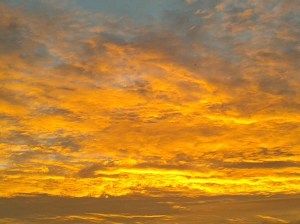
The year begins in darkness a deep purple darkness where we long for light and the bright shimmer of a star is a sign of hope and life. In the Liturgical Year, purple or violet is a colour of longing, renewal and expectation: in Advent and Lent, at funerals or in the Sacrament of Penance, purple should speak to us of that which we long and yearn for: like a deer longs for running streams, so we yearn for the living God to come to us, to heal us, to be with us. Our purple is a sign of all we long for: the presence of Christ, the washing clean of all sin, the resurrection of the dead.

Purple is also a sign of kingship and majesty the One who comes, the One who heals, the One who raises the dead is himself the King who reigns from the cross….The Church and the liturgy should be waiting not quite there yet, just around the corner….Advent is the unfilled glass polished and made ready speaking in its emptiness of what is to fill it.

A new conversion story

20161115_074650

‘Night’s Bright Darkness’ is the story of the poet Sally Read’s conversion from atheism to Catholicism in nine brief months. It opens with a description of Sally as a young student nurse laying out a body for the first time. She doesn’t spare the reader the practical details of handling a dead body. When she had finished, the Irish nurse who was instructing her told her to open the window “to let his soul fly”. However, Sally was an atheist and the idea of the soul seemed like an anachronism.

Her life was not without compassion. She trained to become a psychiatric nurse in order to help the weak and vulnerable. She sought for some spark of personality left in patients whose minds had gone, leaving behind the living husk of the body. When her father died, she didn’t allow herself any delusions. She remained firm in her belief that there was no transcendent being, and that all that was left of her father was his ashes. During this difficult period, her atheist convictions almost pushed her into the void. She describes sitting down one day and saying, “This is hell.”

God did not step in at that point. However, he caught up with her years later when she was living in Italy with her husband and small daughter. Research for a book she was working on, brought her into contact with a priest. ‘Night’s Bright Darkness’ tells the story of how from that small opening her life and convictions were turned upside down.

Some things I like about this book

‘Night’s Bright Darkness’ is not always a comfortable or an easy read, but it is a beautiful book. True to her poetic calling, Sally Read doesn’t waste words. Each passage counts. She gives vivid, succinct descriptions of her life in London and Italy. The story is fast-paced as the fire of her conversion rapidly burns through her previous liberal and atheist beliefs.

At times she grapples with describing experiences which go beyond the logic of the five senses. She describes grace “as if I had been blindly rifling a thick black backdrop before I unexpectedly put a hand through where the two halves of the fabric met.”

The book is not written in strict chronological order. The author has divided it into chapters on the Father, the Spirit, the Son, the Church, the Mother and the Mystery. Each contains relevant reflections on her life before and after she became Catholic. She mentions things which I recognise from my own journey towards the church, but hadn’t really thought about. Writing about her first confession, she says, “The Catholic Church, which I had always seen as wrapped in barbed wire and brambles, was as yielding, accommodating and non-judgemental as a mother.”

Sally Read does not shy away from describing the painful adjustments her family had to make in order to accept not just her new faith, but the fact that she had also changed as a person. I appreciate her frankness in writing about things which are probably experienced by many converts. Conversion affected all of my relationships, and it took some time before I and the others in my life could accept these changes.

This book fills a gap

My own conversion was like a deep, strong current pulling me seemingly unstoppably to a place I had just about sworn I would never go. During this period, I trawled the internet devouring conversion stories in the hope that they would help me understand what was happening.

Most of the stories I found were written by North Americans. Almost all of them described the painful process by which Evangelical Protestants question their church and eventually, despite all their initial objections, turn to the Catholic church for answers. These stories were important. They helped me to understand and answer the questions I had about Catholic faith as someone coming from a Protestant background.

However, I longed to find a conversion story from a culture closer to my own. I also carried the burden of turning away from the church, mocking belief and wanting nothing to do with organised religion.

None of the conversion stories I read during this period described the process of going from almost hating churches to a deep hunger for the Eucharist. However, ‘Night’s Bright Darkness’ fills this gap. It describes how God can turn a life in a completely different direction and replace atheism with the peace of his presence.

It’s important to record these mysteries because the fire of conversion eventually cools. Sally Read says, “We have to remember…, because these feelings, so right and pure, get muddled and muddied in the daily tramp of life and all its obligations. History disappears down the long line of dates; the supernatural recedes into some distant sky.” I appreciate this story, because at a time of doubt and darkness, it has helped me to remember the sure sense of God’s presence which drew me into the church.

Towards the end of the book, Sally Read describes her struggles to bear witness to her faith as a mother, as a writer and translator, as a parishioner organising adoration, and as someone whose love for her faith spills over into conversations. As she says in the last paragraph, this is an unfinished story about an ongoing journey. She writes with insight, honesty and passion, and I hope that she will share more in future books.

No-one has a monopoly on Christ


20160924_190921-2

Last week the Pope visited the Lutheran church in Sweden in order to mark the 500th anniversary of the Reformation.

It might seem strange for a Catholic Pope to commemorate in any positive way an event which caused a seemingly irreconcilable split in the Christian church. However, Pope Francis said, “With gratitude we acknowledge that the Reformation helped give greater centrality to Sacred Scripture in the Church’s life.”

When I first became Catholic, I might have felt threatened by this. I wanted to assert my Catholic identity by kicking against the church I had come from. There was a very great temptation to see everything Catholic as good, and what I had left behind in the Protestant church as bad or at least inadequate.

However, I’ve come to recognise that a part of me will always be Protestant. By becoming Catholic, I didn’t change my personality or my family background. A priest who is a Protestant convert told me to treasure this part of me, because it would make a positive contribution to the church. I didn’t want to listen to him at first. However, I now recognise the wisdom of what he said.

Christ broke down barriers

If Christ was here today, I am sure that he wouldn’t stick to one church and ignore the rest. He would reach out to all sorts of people in many different kinds of churches. He would also hang out with people who wouldn’t dream of darkening the door of a church. Christ would be found in pubs and betting shops and at street corners. He would talk to homeless people in doorways and lost and lonely people in mental hospitals and care homes.

During his ministry, the sharp end of his tongue most often fell on the Pharisees and Sadducees, the religious leaders of his day. He criticised them for burdening people with rules. In the stories he told, the poor and dispossessed are invited to a wedding feast and a father gives the son who squandered his fortune a lavish welcome.

Jesus was someone who tipped over conventions and broke down barriers. He healed on the Sabbath day. He mixed with women. Not only that, he mixed with women from other religious backgrounds. His disciples were astonished to find him conversing with a Samaritan woman. He healed the daughter of a Canaanite woman and the servant of one of the Roman soldiers who was occupying Palestine.

Five hundred years ago, part of the Christian church branched away. Since then it has divided many times. I was brought up in a church which had split at least four times since the Reformation. There are so many differences in interpretation of the Bible and forms of worship that the differences between churches seem irreconcilable. However, what is impossible in a human level is not impossible for God. Perhaps, beneath it all, there is an underlying unity which we miss because we are so concentrated on the surface details.

Recognising the other

What I am sure about, is that Christ is not constrained by our barriers. He sees what we cannot. In an article in the Catholic newspaper, The Tablet, the Lutheran archbishop emeritus, Anders Wejryd, said of the Pope’s visit to Sweden, “When it comes to ecumenism, the first stage is diplomacy. That you acknowledge that the other is there and that the other church is more or less a real church, even if you don’t share all of its opinions.”

He describes what to me is a Christ-like attitude. At a time when politics seems to be increasingly about divisions and Us against Them, it is advice which could be applied not just to religious differences, but to our daily life. Barriers will only be broken down when we learn to see others as they really are.

Mary as Christ’s mother

20160611_185620

Marian devotion was my biggest sticking point when thinking about becoming Catholic. I had no instinct for it. Eventually I decided that since I was convinced about other aspects of Catholic faith, I would trust the church on this one.

Even before I was received into the church, I felt drawn to praying the Rosary. I wouldn’t be without it now. Meditating on the life of Jesus and Mary in this way often brings me peace when nothing else can.

However, I still puzzle over devotion to Mary, the mother of Jesus. Our priest says that people fall into two errors when it comes to devotion to Mary: either they show too much devotion, or not enough. But what is enough? What role does she play? How does she fit into the picture? When praying the Rosary, she sometimes emerges as a concrete, human figure, but at other times she can seem elusive. Most of the time I feel more connected to my favourite saints than I do to Mary, the mother of Christ.

A dream

Recently I had a dream which helped me understand Mary’s role a little better. It was the kind of vivid dream which wakes you in the middle of the night and keeps sleep away for a while. In this dream, I was in a modern-looking church in which benches fanned out in a semi-circle from the altar. I felt apprehensive as I looked around. Many of my relatives and friends were spread out around the church and I knew that they would take a dim view of a Catholic Mass.

When, the priest began, I was on edge, hoping that the Protestant visitors weren’t feeling too out of place. It turned out to be one of those days when a hymn was sung in praise of the Virgin Mary. I felt like sinking through the floor of the church as I imagined the reactions of my Protestant friends. Why on earth did they had to turn up on a day when particular devotion was shown to the Virgin Mary? In my experience, Catholics are much more likely to sing a hymn in praise of the Eucharist than in praise of Mary or the saints.

 At this point, the Protestant visitors began protesting. I can’t remember everything that was said, but they argued strongly against Marian devotion. One of my relatives delivered the final blow. He stood up and declared that Catholics give Mary an equal position to Christ. They claim, he said, that she is co-mediatrix, an equal partner in our salvation.

My faith tottered. I wondered if I was deeply offending God by having any devotion at all to the Virgin Mary. I knew that I had to stand up and say something, but I had no idea what. I got to my feet and to my surprise words came to me. I said that Mary was as much a partner in Jesus’ work of salvation, as my mother was in my getting a degree.

An Analogy

These few words were enough. I awoke. It was dark and I was in my own bed, but the dream still felt very present. When I thought about it, it seemed that I had been given a good analogy.

My mother never had the chance to get a college or university education. She didn’t understand my degree subject, and I enjoyed teasing her by coming out with strange facts which she had trouble accepting. However, without her help, I would never have got a degree. She gave birth to me and brought me up to have a respect for education and knowledge.

My parents provided financial support. My Mum fed me up at half-term and sent me off again with packages of food. She didn’t bat an eyelid when I turned up with some of my strange new friends from university and told her that they needed a meal or a bed for the night. When I was lonely or things were difficult, I called her from a red telephone box in the rain. At the time I took my mother for granted, but now that I’m a mother myself, I appreciate her a lot more. Without her support, I wouldn’t have achieved what I did.

There is a parallel with the role of Mary in God’s plan of salvation. Christ, her son, did it all, and yet she was an essential part of God’s plan. She gave birth to Christ, and brought him up to love others and to love God. She encouraged and supported him, and even followed him to the foot of the cross.

Christ was fully human and yet fully divine. Like other human beings, he didn’t come from no-where. He had a family and that family helped to create the circumstances in which he could carry out his ministry and his work of salvation. Perhaps part of the reason we show devotion to his mother, is because he wants us to join him in appreciating the part she played in his life.

The sacrament

20160608_131519

I want to go to Mass. I don’t want to go.

I am afraid of my impossible expectations. Nothing ever turns out the way I think it should. I fear this unreachable God. I am overwhelmed by the distance between us. I worry that I will take the Eucharist and feel nothing. Most of all, I fear discovering in my deepest, inner self, that there is no God.

I fear longing, and I fear not longing.

I keep my head down, trying to dodge the voice which asks what business I have attending Catholic Mass? I was brought up a doughty Protestant. Who am I kidding that I’ll ever make a good Catholic? My life doesn’t stand scrutiny. If you hold it to the light like an old garment, all you will see is holes.  

At the last moment, when there is really almost no time left, I know I have to go.

I scuttle in at the tail end of the Gloria. Another failure. I am crushed inside.

I tell God about the things which are tearing me apart. I try to turn towards Him, an imperfect, scratched piece of metal, such a dull reflection of His light.

We say Holy, Holy, Holy, Lord God of Hosts. I bend to my knees in relief, hide my face and my tears in my hands, and say, God do with me what you will.

And then I go up for that tiny sliver of bread, a flat little wafer handed over with compassion. I look at it in my palm, hardly bigger than a thumbnail. I can’t take in the thought that Jesus lies there. I really can’t believe it. All I can do is take, eat, kneel and hope and pray that I will experience what I cannot comprehend.

I pray for mercy. I ask that Jesus will come into the hovel of my soul and stay a little while, because I am too weak and small and poor to do anything myself.

I leave the church, forcing a smile and exchanging a few words. I hold things together long enough to take myself off to a quiet place, and then something cracks. Walls, barriers, defences crumble. Tears flow again. I am breaking up inside and I can hardly bear it. There is darkness in front of me. I am afraid to go forward. I can’t go back.

All I can say is, Sweet Jesus, I feel as if you have taken hold of my heart and pulled it out through my mouth. I have nothing left. You have taken it all. You have it all. If you want me to love others, you will have to do it through me, because I am nothing. I have no strength on my own.

We shall not be overcome

20151224_142018

In the last week or so, I have been trying to hold onto St Therese’s image of clinging onto God. When asked to help train novices, she wrote that if she had tried to do the work in her own strength, she would have given up right away.

Returning to work

Recently I have been asking myself what it means to do things in God’s strength. The difficulties I face are so great that I sometimes wonder how I am going to keep going at all. Over the past year or so, I have been trying to start working again.

Giving birth to children, trying to juggle work and childcare, and finally giving up my career and ambitions so that I could bring up my children were huge challenges at the time. However, trying to return to the relentless routine of the workplace is also a difficult period in a woman’s life which, I think, goes largely unrecognised. One minute you are at the beck and call of small people, their needs and sicknesses, and the next you are supposed to be punctual, scrubbed clean, well-ironed and thinking about nothing but professional problems.

It is difficult enough if you are slotting back into the job you were doing before you went on maternity leave (I’ve done that too). However, if your old job is long gone and you have to retrain to do a new one, starting on the very bottom rung, the path ahead can seem impossibly difficult.

Over the last while, I have felt as if I am trying to climb Mount Everest with several kids strapped to my back and without proper equipment. I lumber slowly forwards while lithe young graduates gallop past like gazelles in super-dry clothing with tiny, ultra-lite backpacks strapped to their backs.

A long, long time ago, it feels as if it happened to someone else in a story, although it was actually not much more than a year back, I prayed about whether I should try to do this job. It felt like the right thing to do. In fact, it was the only choice which brought me peace.

It all feels too much

Now that I’m in the thick of it, I just feel confused and exhausted. The job is tiring and there’s so much to learn. Over the last week, the kids and I have all go sick, and what do you do when you have to work and there is no wider family or in-laws or out-laws (to borrow a phrase from one of my in-laws) to help out?

Sometimes it all feels too much. I have conversations with God along the lines of, “Are You sure you’ve got the right person, here? It seems like there’s so many other people out there who could do this job better than me. I keep making mistakes. Some days almost feel like an unmitigated disaster. I’m asking You for help, but all these obstacles appear in the way, including the ones made by my own inexperience.”

Keeping going

Two things keep me going. One is Gerard W. Hughe’s advice based on Ignatian spirituality. He says that in a time of desolation, you should never go back on a decision made in a time of consolation. If I’m honest with myself, I can look back on times when I did enjoy doing this work, and when I felt that I had confirmation that I was on the right path.

The other thing which keeps me putting one foot in front of the other, is the thought that it wouldn’t be faith, and I probably wouldn’t be learning much, if God magically cleared every obstacle out of my path.

I often think of the words of Julian of Norwich, the medieval anchoress who lived alone in a cell attached to St Julian’s church in Norwich.

He did not say, ‘You shall not be tempest-tossed, you shall not be work-weary, you shall not be discomforted.’ But he said, ‘You shall not be overcome.’ God wants us to heed these words so that we shall always be strong in trust, both in sorrow and in joy.

On flowers and small things

20150602_091816

Today I am thinking about a young woman who compared herself to a flower, not a grand, showy one like a rose or a lily, but a simple violet which grows close to the ground. I am talking, of course, about St Therese, otherwise known as the Little Flower, whose saint’s day was celebrated yesterday.

She was born into a middle-class French family, entered a Carmelite monastery at the age of fifteen and died of tuberculosis at the age of twenty-four. Until her death and the publication of her memoirs, hers was a hidden life. She didn’t die a martyr or travel to distant countries proclaiming the Gospel. Her heroism lay in carrying out small acts with great love, such as helping a grumbling, old sister to walk to the refectory, patiently putting up with the strange noise another sister made at prayer or seeking out the company of the people she found least attractive and most difficult.

She compared herself to a weak little bird which was determined, despite its smallness, to head towards the light of the divine. She also described herself as a small  paintbrush which Jesus used to paint the details into his pictures.

Acknowledging weakness

Rather than pretending a strength she didn’t possess, or giving up and saying that she was too small and frail to be used by God, she acknowledged her weakness. Realising the impossibility of reaching God by her own strength, she held out her arms and asked Jesus to pick her up. For that she must be small and humble. In this way, she allowed God to turn her weakness into a strength.

When she was asked to give instruction to the novices, she wrote that she flung herself into God’s arms and told Him that she felt that this work was beyond her strength. However, if He wanted to use her, then she asked Him to fill her hands, to that she could reach out and feed his children without for one moment ceasing to cling to Him.

Recently I have often been thinking of this image of St Therese clinging to God. There are phases in our lives when God allows us to coast along on what appears to be our own strength, and other phases when God allows us to see that we are really nothing without Him. I’m at a stage in my live when what I am expected to do seems to be beyond my strength. I am trying to return to work after having children, and struggling to learn a new job. Some days, I just don’t know how I’m going to keep on doing this. All I can do is acknowledge my weakness and my utter dependence on God.

Doing small things with love

Thomas Merton’s friend Bob Lax said that the aim of every Catholic should not just to be a good Catholic, but to become a saint. St Therese shows that it is possible for anyone, however, small and limited their life, to become a saint by doing small things with love.

When I was younger, I had a career, I travelled the world, I went to conferences and meetings. Now my life is quite different. It is enclosed by a bracelet of small things which simply have to be done: washing the dishes, shopping for food, walking the dog, washing the dog because she’s rolled in something unsavoury (again), cleaning the floor because someone has left a mess on it (again).

It is hard not to get fed up and grumble and sigh. However, rather than becoming annoyed and impatient, St Therese saw these small sacrifices as an opportunity to detach herself from self-love and turn towards God.

I can’t do any big, heroic acts, but the life of the Little Flower gives me hope that God will give me the strength to do small things with love.

A sense of peace

 20160912_195335-2

Peace comes up many times in the Mass, from the opening line of the Gloria, “Glory to God in the highest, and on earth peace to people of good will”, to the priest’s words just before the sign of peace, “May the peace of God be with you always”, and the peoples’ reply, “And with your spirit”, and to the prayer just before communion, “Lamb of God, you take away the sins of the world. Grant us peace.”

Right at the very end, we are sent away with the words, “Go in peace, glorifying the Lord by your life.”

Consolation

A number of years ago, the illness of a close family member caused me great anxiety, and my search for some way of dealing with this pain, brought me into the Catholic church.

At the time, I probably didn’t realise that I was searching for peace. The thought uppermost in my mind was that if I prayed, perhaps, against the odds, my loved one might make a recovery. I had no intention of ever becoming Catholic, but I remember more than once crying all the way through the Eucharistic prayer. Even then I sensed that this was a place and a time when I could hand my burden over to God.

Nothing got better right away, but I found that when I went to Mass, I left with the feeling that I was more able to carry what had seemed too heavy for me to bear. Over time, I began to experience what might be called consolations, glimmers of light when I felt faith rather than just forcing myself to have it because I had run out of alternatives.

Something quite incredible happened. One day I felt that I was being asked to become Catholic. From that moment onwards, I experienced an incredible sense of peace and of God’s presence. It was like living my life with beautiful music playing in the background. All I had to do was be still in order to feel the presence of God.

It is impossible for me now, looking back, to remember exactly what this felt like. It was something I hadn’t experienced before, and I thought it would last forever. I could hardly wait to be received into the church, because I thought that I would be bourn along for the rest of my life on a wave of joy and peace. How wrong I was.

Into the Corryvreckan

The sense of peace and of God’s presence left me quite abruptly. I felt confused and distressed and alone. As I said to our parish priest, I wasn’t just all at sea; I was in the Corryvreckan (a stretch of sea off the Scottish island of Jura where the water can become a turbulent whirlpool depending on the tide).

I felt let down and abandoned. Yet a strong, sure current, under the surface turbulence, still pulled me on. I knew what I had to do. In the middle of these feelings of confusion and desolation, I made the decision to become Catholic.

I still hoped, of course, for consolation, and it was very painful to realise that entering the church didn’t bring back the sense of God’s presence, and that I still had to deal with doubt. Later I read St Therese’s ‘Story of a Soul’, where she describes how the sense of God’s presence left her, plunging her into a spiritual dryness. This continued until moments before her death. Mother Teresa, who recently became a saint for her work with the poor in Calcutta, experienced decades of spiritual darkness and dryness.

I eventually stopped looking for consolation. Basing faith around longed-for moments of joy and peace, was like being a spoilt child who holds out for sweeties. Accepting the doubt and the dryness has made it easier to bear.

God’s presence in the moment

The easy sense of God’s presence has never returned. However, something quite different has happened. Through acceptance, I have experienced moments of intense gratitude for what is, moments when I don’t fret about the future or regret the past. This has brought me to a different kind of awareness of God, perhaps tiny glimpses of what Eckhart Tolle writes about in ‘The Power of Now’, when he describes resting in the presence of God by living in the present moment.

At the start of this journey, I thought that God’s presence was just for me, wafts of peace and joy to insulate me from the pains of life. However, I am discovering that God’s peace brings a kind of restlessness. When I begin to feel gratitude for what I have, that makes room for an awareness of those who have much less. I am brought back round to the last words of the Mass, the words I used to dread, because it meant the end of a little pocket of peace, and a return to the daily difficulties of life: “Go in peace, glorifying the Lord by your life.”

I am not sure how this last bit will work out in my life. I wrote this post a few weeks ago, and didn’t have time to post it because I started a challenging new job which has brought quite a bit of un-peace. I would appreciate prayers. Thank you.

Beach clothes

20160828_171342

Last week brought images of a woman on a beach in the south of France being asked by armed guards to either leave the beach or remove, yes remove, her over-shirt. She was dressed in leggings, headscarf and long shirt. Apparently her modest clothing was not secular enough to fit in with the new regulations on France’s beaches, where the burkini is banned (a full body swimsuit worn by some Muslim women).

I don’t get it

I just don’t get it. When I go to the beach, I am usually pretty much covered in clothes from head to toe, and no-one complains. Admittedly this is Scotland where there is almost always a stiff wind coming off the sea. If I venture near a beach in winter, I usually wear a long coat, jeans, boots and a hat. I have a scarf pulled up so that only the bridge of my nose and my eyes are showing. In fact, I don’t show any more skin than if I was wearing a burka.

Recently it’s actually been warm enough to wear a swimsuit. While the locals show off plenty of tender, white skin, visitors from sunnier climes, who don’t realise that 15 degrees Centigrade is a heat wave, have enjoyed the weak, northern sun in jeans, long shirts and jumpers and wide-brimmed hats. No-one has asked them to strip off.

Something has gone wrong if women are targeted for wanting to cover themselves up. The pressure to keep up with fashion and show off your body can be just as much of a restriction on women’s freedom as covering up for religious reasons. In the Highlands of Scotland, many women cover their heads to go to church and long skirts are de rigeur for the older generation. A look at photos of Victorian woman’s bathing attire will show something which resembles a baggier, lycra-free version of the burkini.  If a woman feels more comfortable covered up, the decision should be left to her.

Love

The secular laws in France are, whether or not that was the original intention, targeting Muslims and in particular, targeting women, themselves a more vulnerable group. In the UK, there is also a tendency to react to terrorist acts, or simply to the fact of being in contact with those from another culture and religion, by perceiving our Muslim neighbours as oppressive and potentially violent.

Last week I had a reminder that the heart of the Muslim religion is love. I watched a wonderful DVD called Bab’Aziz or The Prince who contemplated his soul. It is based around the ideas of Sufi mysticism, and is a visually beautiful film about a blind dervish and his granddaughter who wander through the desert looking for a gathering of dervishes. Their journey through the desert is a metaphor of the journey of the soul. It is demanding to watch, slow in places and then switching quickly to follow the stories of the different characters who are encountered on the way.

I cannot describe the effect that this film had on me, except to say that it left my soul panting for God as the deer pants for the water. At the end, I wanted to run to God, as a child runs to her Father, and tell Him that I wanted to give Him everything, except that my hands were too small to hold whatever that everything is. It will take a lifetime to scoop up small handfuls and offer it back to Him.

The film left me with the same feeling I have whenever I have the privilege of talking to an elderly friend of mine who is a Sufi. I recognise the hunger for God and the search for God in the other, and that lights the flame in my own heart. It seems to me that although, on the surface, there are many different traditions and ways of approaching God, underneath there is only one way and that is love, which is the hardest way of all. From Bab’Aziz:

The people of this world are like the three butterflies in front of a candle’s flame. The first one went closer and said, ‘I know about love’. The second one touched the flame lightly with his wings and said, ‘I know how love’s fire can burn.’ The third one threw himself into the heart of the flame and was consumed.

Only say the word

20160808_144923

The title for this post comes from the words of the Centurion to Jesus when he asked him to heal his sick son: Lord, I am not worthy that you should enter under my roof, but only say the word and my son shall be healed. I think that they are some of the most beautiful words in the Bible.

Images of my soul

When I was a child, I thought of my soul as a small, wrinkled, prune-like organ. It was located somewhere in my head, probably right at the back.

As I grew older, I realised that the soul is not a physical organ like the heart and the liver. I stopped thinking much about it, and even questioned whether it existed.

When I began attending Mass, I still didn’t have any more than a vague belief in God, but the prayer said just before Communion, based on the Centurion’s words, made a huge impression on me: Lord, I am not worthy that you should enter under my roof, but only say the word and my soul shall be healed.

Now I had a new image for my soul as a windowless hovel. It was a dark, damp place that had once had strange, failed ambitions of grandeur. The walls were covered in peeling wallpaper and rotting wood panelling, which was falling off the walls.

Healing

As I watched other people go up to take the Eucharist, I imagined what sort of work Jesus would have to do if he came under my roof.

First of all, he would open the tightly shut door, and let light and fresh air into the dirt and decay. He would light a fire to warm the damp interior. Each week at Mass, I tried to give Him permission to strip away a little more of my ego and false securities. I imagined Him patiently pulling off layer after layer of old wallpaper and rotting wood and burning it on the fire.

This was a very painful process, because I had deeply entrenched ideas of what I wanted to do for my own power, honour and glory. Each time when I thought that I had opened my hands and tried to let go of everything, I discovered another layer of worthless rubbish stubbornly clinging to the walls.

Yet another image of the soul

This work of stripping away what isn’t necessary, and trying to orientate myself towards God, will be a lifelong task. I can only co-operate in it. Alone, I am powerless to change myself.

Recently another gentler image of the soul has floated into my mind. I see a modern, furnished room. I can’t quite picture the walls or the dark corners, but I do see a zebra-print sofa with red cushions. Don’t ask me why this is in the image. I can be a bit eccentric, and I do admit to owning a pair of zebra-print pyjamas. However, I wouldn’t be seen in public wearing animal prints, and I can safely say that I would never choose a zebra-print sofa.

The décor is a bit bizarre, but this image of my soul is of a room where someone might conceivably sit and rest for a while.

Recently I was assailed by doubts and feelings of inadequacy. I felt as if God was saying that there is a place and time for recognising faults. However, if I only concentrate on them, it’s like turning off the light and heat in the room. Very quickly, my soul once again becomes a dark, dank place where no-one wants to stay for long.

A place to rest

I would like my soul to be a place where Christ can come and rest for a while. Sometimes I wonder, how I can redd it up for him. Redd it up is what we say in Scotland when we are cleaning to get ready for something. For instance, when I was a child, we redd up the house and gave it a good clean for the New Year. My mother gave all of us jobs to do.

This brought me to think that Mary was the person who redd up the house for Christ when He was a child. She would have wanted the place he stayed to be clean and tidy for Him. Now I am wondering if this image of Mary redding up the house, is going to get me a little closer to the role of Mary. As Christ’s mother wouldn’t she want our souls to be warm and welcoming places for Him?

Our parish priest says that Mary’s role is to lead us to Christ and Christ brings us to the Father. I still don’t understand what this means. However, I wonder if these images of my soul are bringing me a little closer.